Most small restaurants do not have a restaurant marketing plan. They post when they remember, run a promotion when it is slow, and hope for the best. You do not need an agency or a 40-page deck to do better. You need one page that answers six questions, and the discipline to check your numbers every month. Here is a template you can fill in this week.
The one-page template
| Section | Question to answer | Example |
|---|---|---|
| 1. Goal | What one number do we want to move in 90 days? | Grow weekday lunch sales by 15% |
| 2. Audience | Who are our best guests and where are they? | Office workers within a mile, 25–45 |
| 3. Offer | Why should they choose us this quarter? | A fast lunch combo, ready in 10 minutes |
| 4. Channels | Which three channels will we use? | Google Business Profile, Instagram, online ordering |
| 5. Budget | How much per month, in money and hours? | $400 a month and 3 hours a week |
| 6. Measure | How will we know it worked? | Weekday lunch sales and online orders in POS reports |
Step 1: Pick one goal
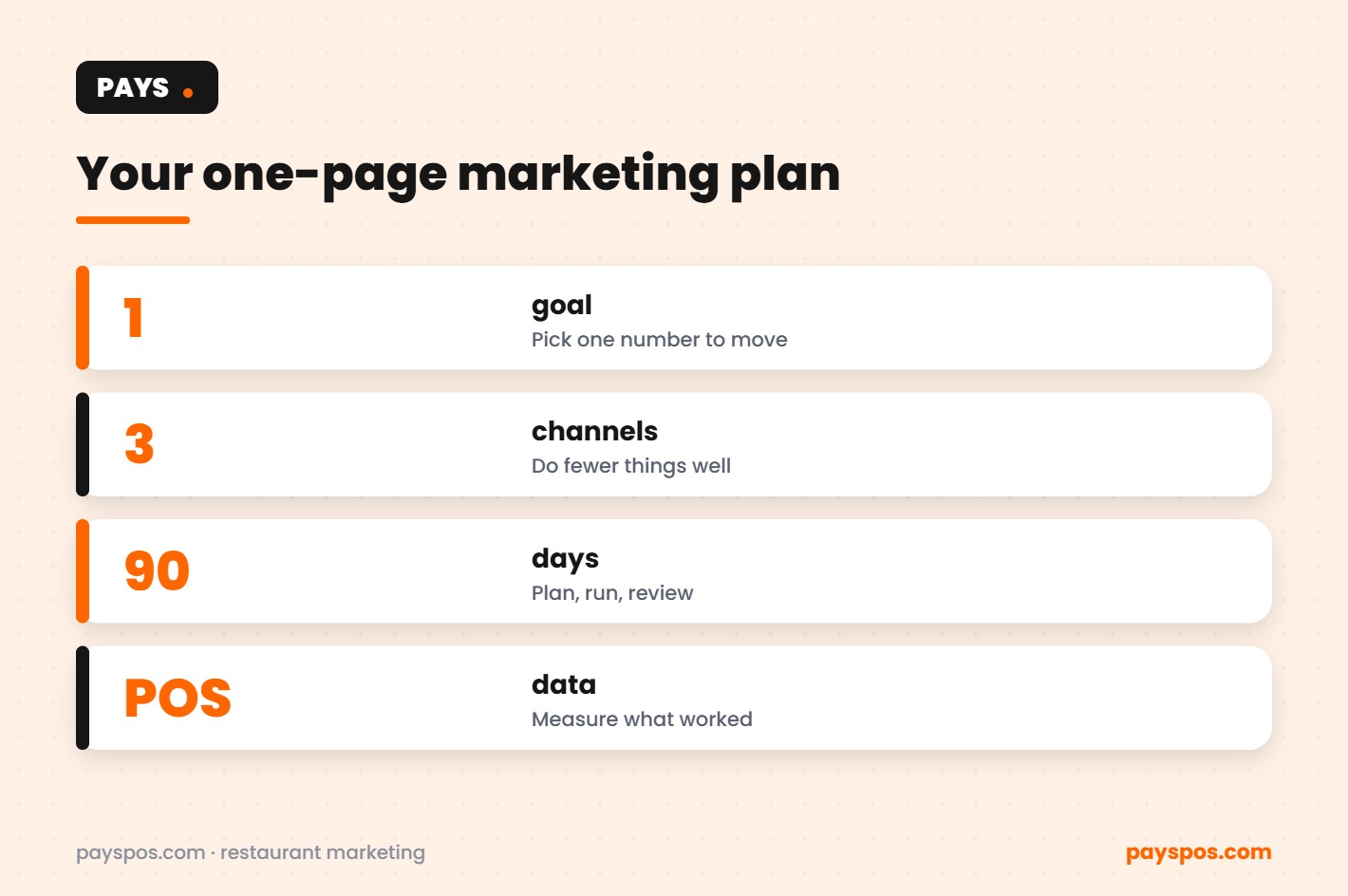
“More customers” is not a goal. “Grow weekday lunch sales by 15% by the end of March” is. One clear goal tells you which channels matter and which do not. Good restaurant goals include filling slow days, growing online orders, increasing average check, or bringing back lapsed regulars.
Step 2: Describe your best guests
Write two sentences about the guests you want more of: who they are, when they come, what they order and how they find you. Your POS data helps here: look at your busiest times, top items and the share of orders from dine-in, online and delivery apps.
Step 3: Choose three channels
Small teams do best with three channels done well rather than ten done badly. Strong options for most restaurants:
- Google Business Profile: accurate hours, menu, photos and fresh reviews. Read our guide to getting more Google and Yelp reviews.
- Instagram or TikTok: short videos of food being made and the people behind it. See our tips on restaurant social media.
- Your own online ordering: every direct order avoids app commissions and builds your customer list.
- Email or text: the cheapest way to bring regulars back.
- Local partnerships: offices, gyms, schools and events nearby.
- Delivery apps: reach new guests, then win them over to ordering direct.
Step 4: Set a budget you can keep
Consistency beats big one-off spends. Decide a monthly amount and the hours someone will actually spend. For a deeper look at what restaurants typically spend, see what marketing costs for a restaurant.
Step 5: Fill a 12-week calendar
| Weeks | Focus | Example actions |
|---|---|---|
| 1–2 | Foundations | Update Google profile, photos, menu, online ordering link everywhere |
| 3–6 | Launch the offer | Lunch combo posts twice a week, flyers to nearby offices |
| 7–8 | Reviews push | Ask happy guests for reviews, reply to every review |
| 9–10 | Regulars | Text or email offer to past guests |
| 11–12 | Review and plan | Compare results, keep what worked, plan next quarter |
Step 6: Measure with your POS
Marketing only works if you can see the result. A POS with real-time reporting shows sales by day, hour, item and channel, so you can tell whether the lunch push moved lunch sales, or whether online orders grew after you added your ordering link to Instagram. PAYS includes real-time reporting, online ordering and Uber Eats, DoorDash and Grubhub integration in one system, so every channel shows up in the same reports.
Common restaurant marketing mistakes
- Discounting without a goal, which trains guests to wait for deals.
- Posting without a plan, then stopping when it gets busy.
- Ignoring Google reviews and outdated hours.
- Sending every guest to delivery apps instead of your own ordering.
- Never checking whether anything worked.
A filled-in restaurant marketing plan example
Here is what a completed plan might look like for a neighborhood taco shop that is busy on weekends but quiet on weekday afternoons.
- Goal: grow Monday to Thursday sales between 2 pm and 5 pm by 20% in 90 days.
- Audience: students and remote workers within walking distance, plus nearby office teams ordering snacks.
- Offer: an afternoon taco-and-drink combo, available in store and through online ordering.
- Channels: Google Business Profile updates, two short Instagram videos a week, and flyers at the nearby college and co-working space.
- Budget: a modest monthly amount for flyers and a small boosted post, plus two hours a week from the manager.
- Measure: afternoon sales by day and the number of combo orders, checked every Monday in POS reports.
After six weeks, the reports show combo orders growing steadily through online ordering but flat in store. The team moves more effort to Instagram, where the ordering link lives, and stops the flyers. That is the plan working exactly as it should: test, measure, adjust.
Low-cost tactics that fit almost any plan
- Photograph your top five dishes well. Use them everywhere: Google, social, online ordering and kiosk screens.
- Reply to every review. Thank the happy guests, fix what the unhappy ones raise.
- Put your ordering link everywhere. Receipts, bags, boxes, table tents, social bios.
- Celebrate your team. Behind-the-scenes posts of real staff consistently connect with locals.
- Partner locally. Offer catering trays to nearby offices or a discount for a local team after games.
- Bring back lapsed regulars. A simple message to guests who have not visited in a while can work surprisingly well.
Reviewing your plan each month
Set a recurring 30-minute slot. Pull sales by day, hour, item and channel from your POS, compare them with the month before, and ask three questions: what moved, what did not, and what will we change next month? Write the answers on the same page as your restaurant marketing plan so the whole team can see them. Over a year, those twelve short reviews will teach you more about your guests than any agency report.
For more on the sections of a marketing plan, see the U.S. Small Business Administration guide to marketing, sales and accepting payments.
Comparing marketing channels at a glance
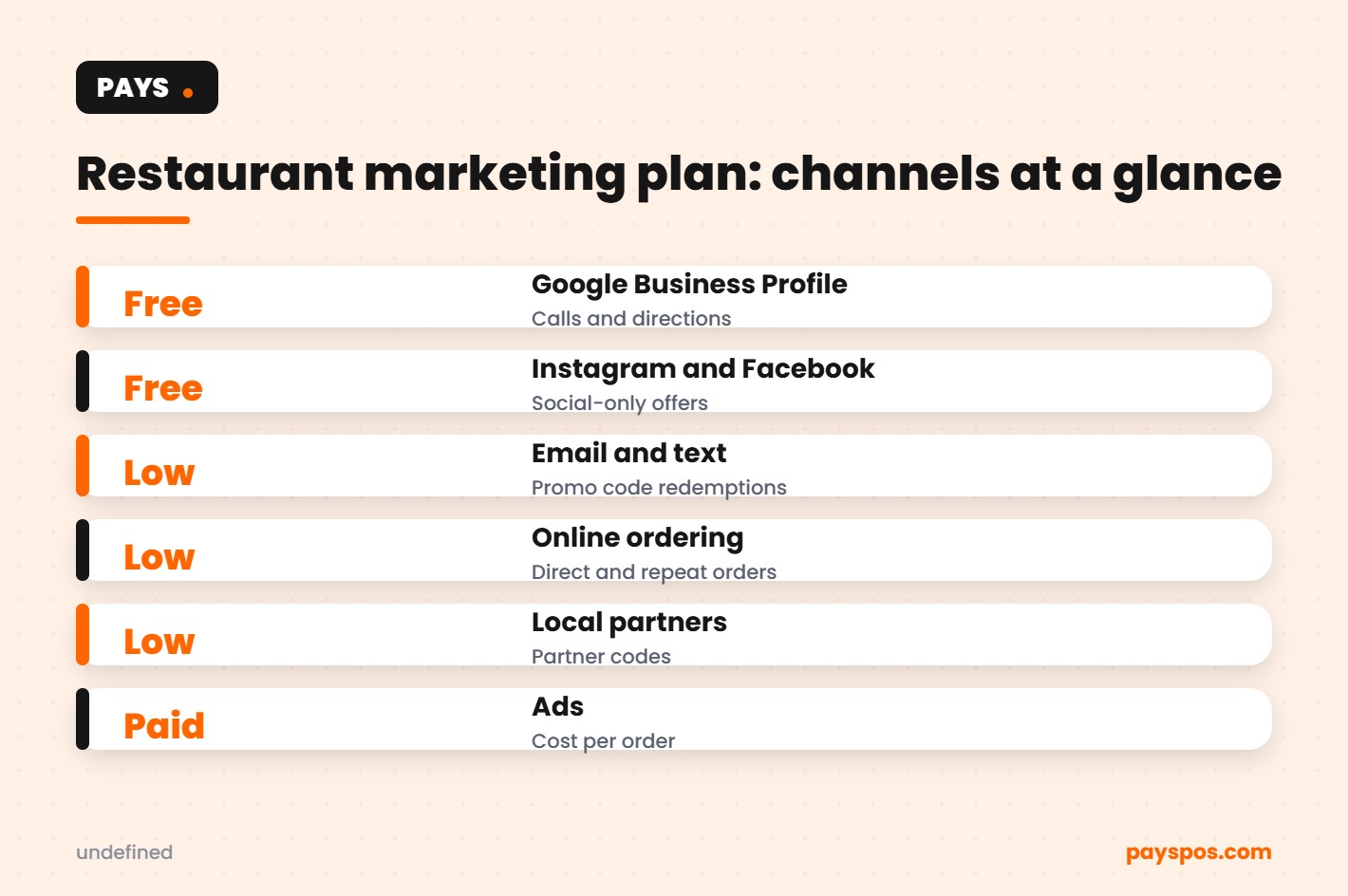
Every channel in a restaurant marketing plan costs something, whether it is money, time or both. This comparison helps you choose the three that fit your team.
| Channel | Cost | Time needed | How to measure it |
|---|---|---|---|
| Google Business Profile | Free | Low | Calls, direction requests and website clicks |
| Instagram and Facebook | Free to low | Medium | Reach, saves and redemptions of social-only offers |
| Low | Low to medium | Opens, clicks and promo code redemptions | |
| Text messages | Low to medium | Low | Redemptions and replies |
| Online ordering on your own site | Low | Low once set up | Direct orders and repeat orders |
| Local partnerships | Low | Medium | Partner-specific codes or coupons |
| Paid ads | Medium to high | Medium | Clicks, orders and cost per order |
Start with the free and low-cost channels. Add paid ads only when you know which offers and audiences already work.
A seasonal calendar for your restaurant marketing plan
A year of marketing feels much lighter when the big moments are mapped out in advance. Use this as a starting point and add your own local events.
- January: Lighter menu items, gift card redemptions and a loyalty push to bring back holiday guests.
- February: Valentine’s Day dinners and takeout specials for couples staying in.
- March and April: Spring menu launch, patio opening and local sports playoffs.
- May: Mother’s Day brunch and graduation party catering.
- June to August: Summer drinks, patio events and family meal deals during school holidays.
- September: Back-to-school lunch and weeknight family bundles, plus football season.
- October: Fall menu and themed events.
- November: Thanksgiving catering, large orders and early gift card sales.
- December: Holiday parties, group bookings and gift cards.
Setting up your Google Business Profile
For many restaurants, the Google Business Profile is the single most valuable free channel in a restaurant marketing plan. It is often the first thing a hungry guest sees.
- Claim and verify your profile.
- Add accurate hours, including holiday hours.
- Link your menu and your online ordering page.
- Upload fresh, appetizing photos every month.
- Reply to every review, positive or negative, politely and quickly.
- Post updates for new dishes, events and specials.
Email and text in your restaurant marketing plan
Social platforms can change their rules overnight, so a strong restaurant marketing plan never relies on them alone. Your own email and text list cannot be taken away. Collect contacts with permission at checkout, through online ordering and with a simple sign-up offer. Then send something useful, such as a new dish, a weeknight deal or an event invite, a few times a month. Keep messages short, add one clear offer and track redemptions with a unique code in your POS.
Restaurant marketing plan ideas by type of restaurant
Quick service and fast casual
A quick service restaurant marketing plan should focus on speed and convenience. Promote online ordering, kiosks and lunch bundles. Track direct online orders and average ticket each week.
Full-service restaurants
A full-service restaurant marketing plan should focus on occasions. Date nights, birthdays, private dining and holiday parties bring in larger checks. Track reservations, covers and average check size.
Coffee shops and bakeries
Here the restaurant marketing plan should focus on habit. Morning regulars are the heart of the business. Use simple rewards and new seasonal drinks to give people a reason to visit more often.
Bars
For bars, the restaurant marketing plan should focus on events. Trivia nights, live music, game days and happy hours fill slow nights. Track sales by hour to see which events actually work.
Pizza and delivery-led restaurants
For these brands, the restaurant marketing plan should focus on direct orders. Every order through your own website instead of a delivery app protects margin. Promote a reason to order direct, such as a direct-only deal.
Restaurant marketing plan scenarios
The quiet Tuesday
A family restaurant sees Tuesday sales at half of any other weekday. It adds a kids-eat-free offer for Tuesday nights, promotes it by email and on its Google profile, and tracks the offer code in the POS. After six weeks, the reports show whether Tuesday traffic grew enough to cover the cost of the offer.
The delivery app dependence
A pizzeria gets most of its orders through delivery apps and loses a large share of each sale to commissions. Its restaurant marketing plan shifts focus to its own online ordering, with a small direct-order discount and a flyer in every delivery bag. Within a few months, a growing share of regulars order direct.
The new opening
A new café opens with no following. It focuses on three channels: a complete Google Business Profile, daily Instagram posts showing the food being made, and a partnership with the gym next door. Each channel has its own offer code, so the owner knows exactly which one drives visits.
Restaurant marketing plan glossary
- Channel: A way of reaching guests, such as email, social media or a local partner.
- Offer code: A unique code used to track which campaign drove a sale.
- Redemption: A guest using an offer or code.
- Average check: Total sales divided by the number of checks.
- Cover: One guest served.
- Direct order: An order placed through your own website or app, not a third party.
- Return on spend: The sales a campaign brings in compared with what it cost.
Key takeaways
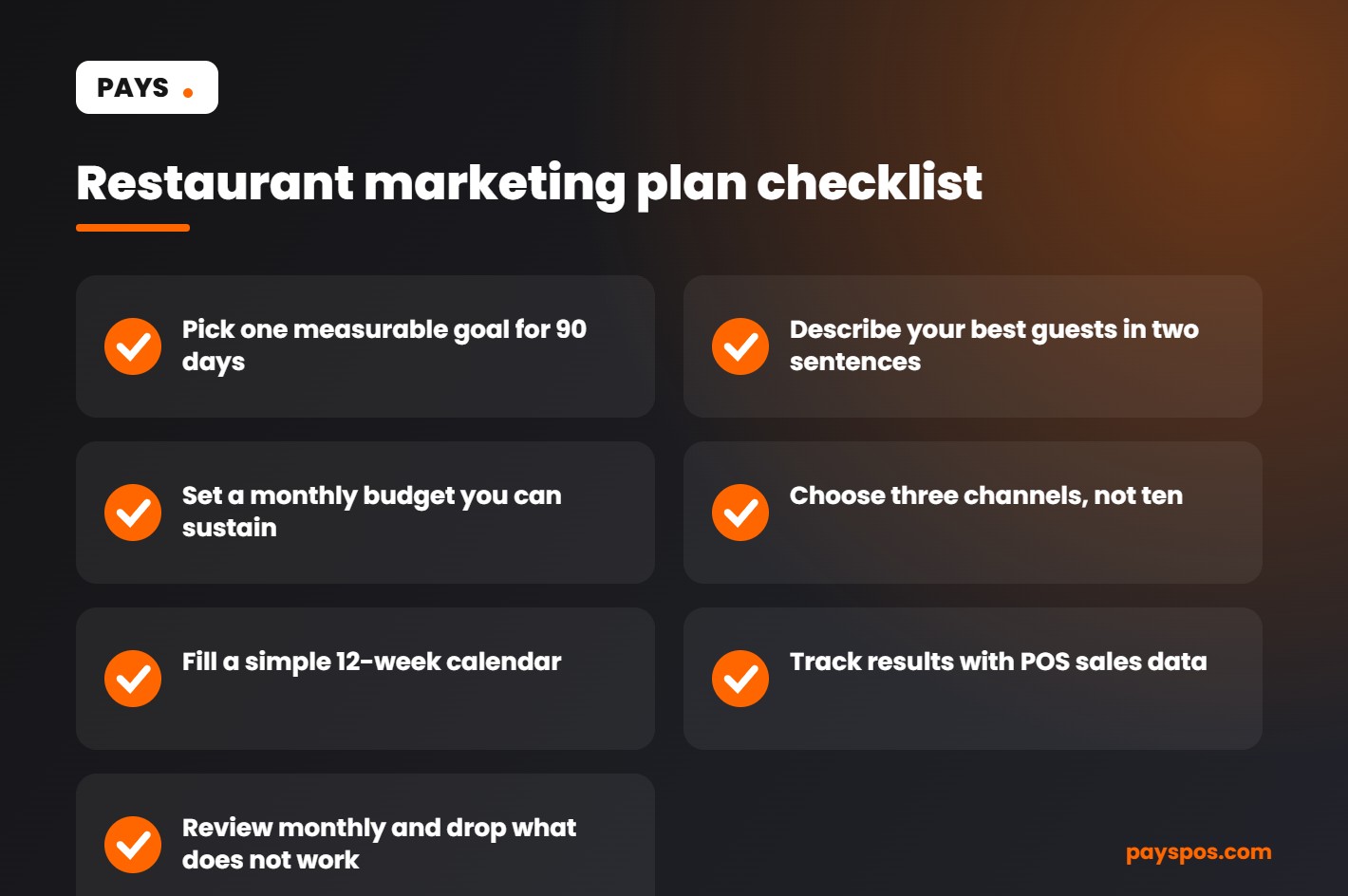
- A restaurant marketing plan works best with one goal, one guest type and three channels.
- Start with free channels like Google Business Profile, social media and your own guest list.
- Plan the year around seasons, holidays and local events.
- Give every campaign its own code and measure it in your POS reports.
- Review the plan every month and keep only what works.
How much to spend on a restaurant marketing plan
There is no single right number. Many operators use a small percentage of sales as a starting rule of thumb, then adjust based on results. New restaurants often spend more in their first year to build awareness, while established ones can lean on regulars and word of mouth.
- Start with a monthly cap you can sustain. Consistency beats one big burst.
- Split the budget across your three channels. Give each enough to test properly.
- Keep a small reserve. Use it for local events or opportunities that come up mid-month.
- Cut what does not work. If a channel brings no measurable sales after two months, move the money elsewhere.
Local partners in a restaurant marketing plan
Neighbors can be the best marketers in your restaurant marketing plan. Gyms, offices, schools, hotels, salons and local sports teams all have audiences who eat out. Offer a simple partner deal, such as a discount for members or catering for their events, and give each partner a unique code. Partnerships cost very little and often bring in guests who become regulars.
Using reviews in your restaurant marketing plan
Guests read reviews before they visit. Ask happy guests to leave one, with a friendly line on the receipt or a follow-up email. Reply to every review, thank guests for kind words and respond calmly to complaints with a way to make things right. Share the best reviews on social media and in emails. A steady stream of recent, genuine reviews builds trust faster than almost any paid ad.
Turning your POS into a restaurant marketing plan tool
Your POS already knows what guests buy, when they come in and how much they spend. A restaurant marketing plan built on that data is far more accurate than one built on guesses.
- Find your slowest hours. Sales by hour show exactly when a promotion is needed.
- Promote what makes money. Item reports show your best sellers and your most profitable dishes. Feature those in photos and posts.
- Track every offer. Set up each campaign as its own discount or code so redemptions appear in real-time reports.
- Grow direct orders. Online ordering through your own site keeps more of every sale than third-party apps.
- Use dual pricing thoughtfully. Clear cash and card prices help protect margin, leaving more room in the budget for marketing.
With PAYS, real-time reporting, online ordering and Uber Eats, DoorDash and Grubhub orders all live in one system, so it is easy to see which channels bring in guests and which only bring in costs.
A restaurant marketing plan does not need to be complicated. One page, one goal, three channels and a monthly review are enough to fill more seats and grow more direct orders, one season at a time.
Print your one-page restaurant marketing plan, pin it in the office and review it with your managers every month. A plan everyone can see is a plan everyone follows.
Frequently Asked Questions
What should a restaurant marketing plan include?
A goal, a description of your best guests, an offer, three channels, a budget and a way to measure results, ideally on one page.
How much should a small restaurant spend on marketing?
It varies by concept and market. Pick an amount you can sustain every month and judge it by results in your sales data.
Which marketing channel works best for restaurants?
For most local restaurants, an accurate Google Business Profile with fresh reviews, plus your own online ordering, gives the most return for the least effort.
How do I know if my marketing is working?
Compare sales by day, hour, item and channel in your POS before and after each campaign.