You’ve just been offered two partner agreements. One calls you an ISO. The other talks about joining as an MSP. Both promise strong residuals, great support and “the best rates in the industry.”
So which one is better?
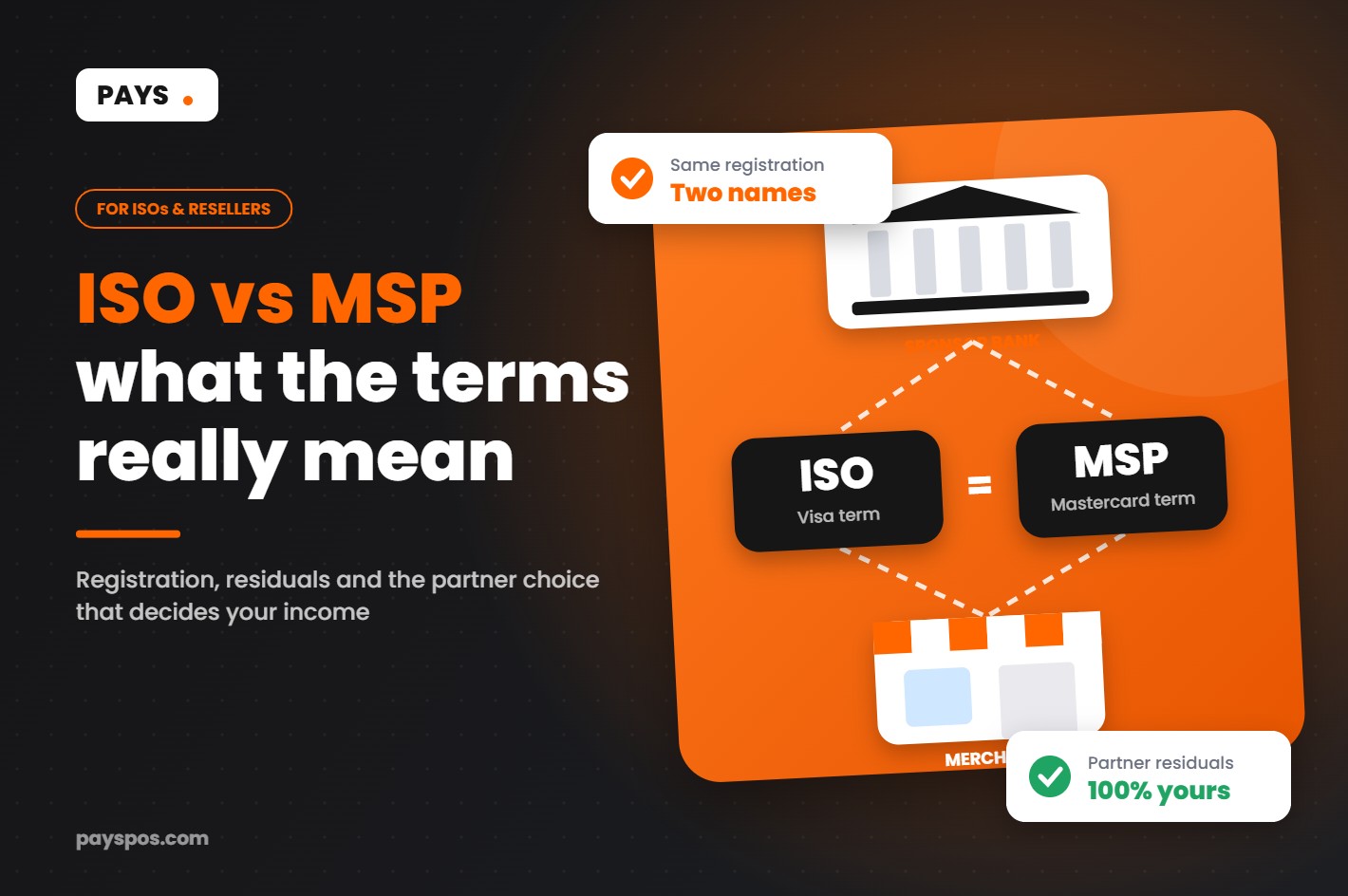
Here’s the part most sales decks skip: ISO and MSP describe the same thing. The ISO vs MSP question is really a question about vocabulary. The decision that actually shapes your income is hidden in the contract, not in the label.
This guide clears up the ISO vs MSP confusion once and for all, explains how registration really works, and walks through the costly mistakes resellers make when they choose a merchant services partner. If you sell payments, POS or both, it’s worth ten minutes of your time.
ISO vs MSP: The Short Answer
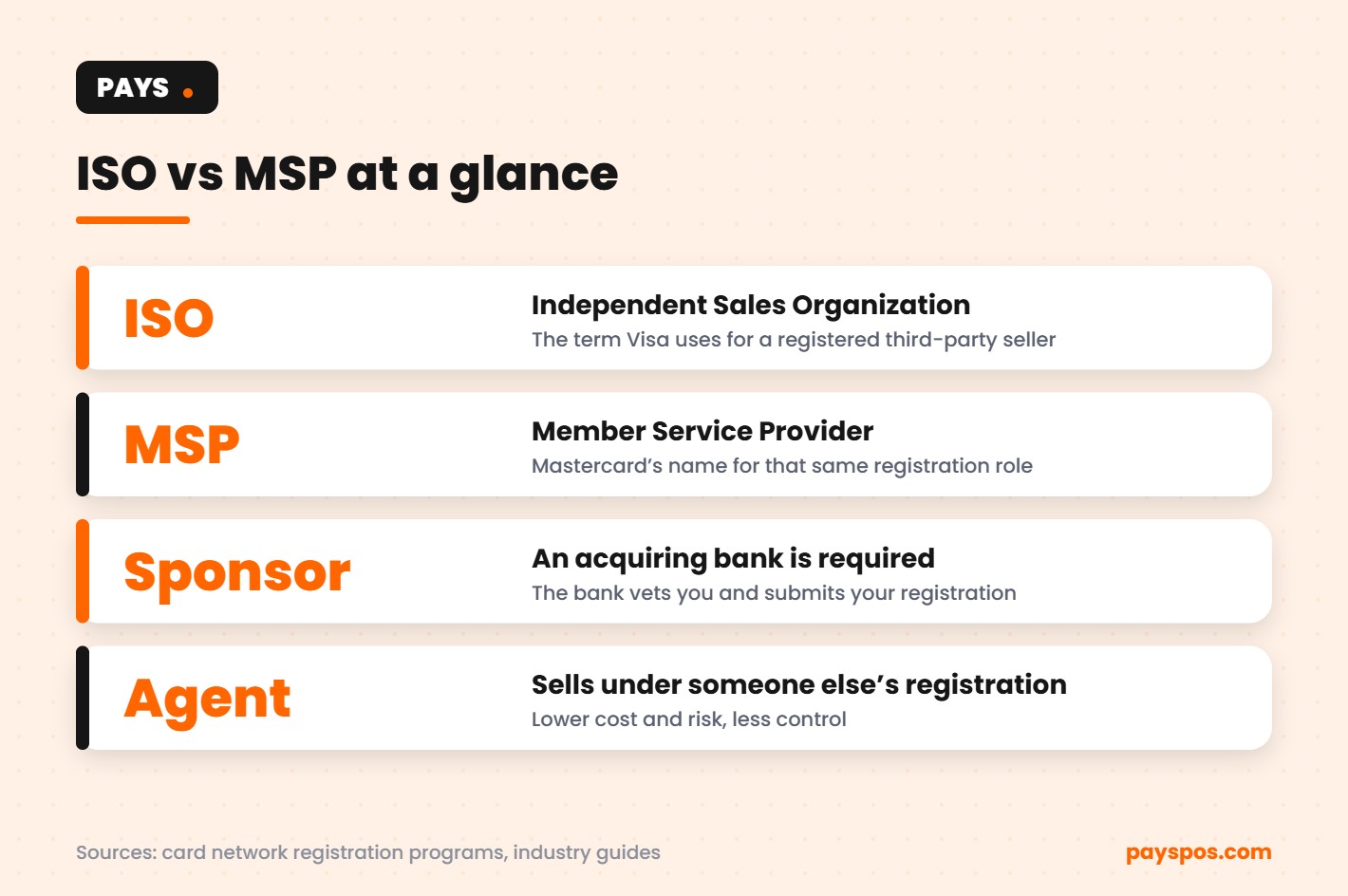
An ISO (Independent Sales Organization) is a non-bank company registered with the card networks, through a sponsor bank, to sell and support merchant accounts. “ISO” is the term Visa uses.
An MSP (Member Service Provider) is the same role under Mastercard’s registration program. Many companies hold both registrations, which is why you’ll often see the combined term ISO/MSP.
So in the strict, card-network sense, ISO vs MSP isn’t a choice between two business models. It’s one business model with two names.
Why the ISO vs MSP Confusion Exists
If the two terms mean the same thing, why does everyone treat them as different? Two reasons.
1. MSP has a second meaning. Outside card-network rules, “MSP” is also used loosely to mean merchant services provider: any company that offers merchant accounts, processing, terminals or gateways. In that broad sense, processors, POS companies and payment platforms can all be called MSPs.
2. Marketing blurs the lines. Some programs call their partners “ISOs” to sound more independent. Others use “MSP” to sound bigger. Neither label tells you who owns the merchants, how residuals are paid or what you’re allowed to sell.
That’s why the smartest resellers stop comparing ISO vs MSP and start comparing contracts.
How the Payments Chain Actually Works
To understand where an ISO/MSP fits, it helps to see the whole chain behind a single card swipe:
- The merchant accepts a card at a restaurant, store or online checkout.
- The ISO/MSP signed the merchant up, set their pricing and supports the account.
- The processor moves the transaction data between the merchant and the card networks.
- The acquiring (sponsor) bank holds the merchant relationship with the networks and settles funds to the merchant.
- The card networks (Visa, Mastercard and others) set the rules and route the transaction.
- The issuing bank approves or declines the cardholder’s purchase.
The ISO/MSP sits in the sales and service layer. It doesn’t move money itself. Its value comes from finding merchants, keeping them happy and earning a share of processing revenue, known as residuals, every month.
The Real Choice: Registered ISO, Sub-ISO, Agent or Referral Partner
Once you see ISO vs MSP as two names for one registration, the real question becomes: how close to that registration do you want to be?
| Model | What it means | Control | Cost and risk |
|---|---|---|---|
| Registered ISO/MSP | Holds its own Visa and Mastercard registration through a sponsor bank | Highest | Highest: fees, capital, compliance and liability |
| Sub-ISO | Operates under a larger ISO’s registration with its own sales team | High | Moderate |
| Agent | Sells merchant accounts under a partner’s registration | Varies by contract | Low |
| Referral partner | Passes leads in exchange for a fee or small residual | Low | Lowest |
Most people searching ISO vs MSP are really trying to decide between becoming fully registered or partnering with an established program as an agent or sub-ISO.
What It Takes to Become a Registered ISO/MSP
Becoming registered is a serious step. As Global Payments explains in its guide to ISO registration, the path generally looks like this:
- A written business plan showing your target merchants, volume and risk controls.
- A sponsor bank. Only an acquiring bank that is a card network member can sponsor you. The bank reviews your finances and background before agreeing.
- Card network registration. Your sponsor submits you to Visa (as an ISO) and Mastercard (as an MSP). Registration carries fees that commonly run into the thousands of dollars per year.
- Time. Depending on the sponsor and networks, the process can take from several weeks to several months.
- Ongoing compliance. Disclosure rules, PCI requirements, monitoring of chargebacks and responsibility for the merchants in your portfolio.
For established sales organizations with real volume, registration can make sense. For many resellers, especially those focused on restaurants and retail, a strong partner program delivers most of the upside with far less overhead.

ISO vs MSP vs Payment Processor
Another common search is ISO vs payment processor, and it’s a fair question, because the roles often get mixed up.
A payment processor runs the technology that moves transaction data between the merchant, the card networks and the banks. It authorizes, captures and settles transactions at scale.
An ISO/MSP sells and supports merchant accounts that run on a processor’s platform. It finds merchants, prices their accounts, helps with setup and handles support questions. It earns a share of the processing revenue rather than running the rails itself.
Some large companies do both, which adds to the confusion. But for most resellers, the key point is simple: you don’t need to be a processor to earn from processing. You need the right partner relationship, and, ideally, the freedom to work with more than one processor.
ISO vs MSP vs PayFac
A payment facilitator, or PayFac, is a different model again. Instead of each merchant getting its own merchant account, a PayFac boards many small merchants as sub-merchants under one master account. That makes signup very fast, which is why PayFac models are popular with app-based and very small businesses.
The trade-offs are real, though. Sub-merchants usually get less individual pricing flexibility, and the PayFac carries more direct responsibility for risk and compliance. For restaurants and retailers with steady volume, a dedicated merchant account sold through an ISO/MSP or partner program often offers better pricing and more control.
When you hear ISO vs MSP vs PayFac in the same breath, remember: ISO and MSP are one role with two names, while PayFac is a genuinely different structure.
Residuals: Where the ISO vs MSP Decision Really Pays Off
Residuals are the monthly income you earn from the processing volume of the merchants you sign. Over time, a healthy portfolio of residuals becomes a valuable, recurring asset. That’s why the terms matter so much more than the title.
When you compare any two programs, look at:
- The split. Many traditional programs share somewhere around 30% to 50% of the processing margin with partners. Others offer much more.
- Portfolio ownership. Do you own the merchant relationships, or does the partner? Ownership determines whether your residuals can be sold, moved or lost.
- Vesting and minimums. Some programs pay residuals only while you hit monthly production targets.
- Clawbacks. Early merchant cancellations can trigger repayments of bonuses you’ve already received.
- Transparency. Can you see the buy rate, the fees and the exact calculation behind every payout?
Two partners can both call you an ISO and still offer completely different futures. That is the real lesson of ISO vs MSP.
7 Costly ISO vs MSP Mistakes Resellers Make
1. Choosing a Partner by Label
As we’ve covered, ISO vs MSP is mostly terminology. Choosing one program because it says “ISO” in the headline tells you almost nothing about what you’ll earn.
2. Ignoring Who Owns the Portfolio
If the partner owns your merchants, you’re building their business, not yours, whatever the ISO vs MSP label says. Ask directly, and get the answer in writing.
3. Accepting Processor Lock-In
Programs tied to a single processor limit what you can offer. If that processor raises prices or declines a merchant category, you have nowhere to go. Flexibility to use more than one processor protects both you and your merchants.
4. Selling Proprietary Hardware
When terminals and POS hardware only work with one processor, merchants feel trapped, and trapped merchants complain, churn and leave bad reviews. Open hardware makes your offer easier to sell and easier to keep.
5. Overlooking the Software Layer
Today’s merchants don’t just buy processing. They buy a POS with online ordering, kitchen displays, kiosks and reporting. Partners who only offer a merchant account leave you competing on rate alone, which is a race to the bottom.
6. Underestimating Onboarding Time
Every day a merchant spends waiting for setup is a day they might change their mind. Slow boarding, manual menu builds and long training cycles cost you deals.
7. Signing Long Contracts You Can’t Exit
Long-term agreements with early termination fees can lock you into a partner long after the relationship stops working. The same applies to the contracts your merchants sign.
Why POS Changes the ISO vs MSP Equation
In the ISO vs MSP conversation, POS rarely gets mentioned. It should. A merchant account on its own is easy to switch. A POS system that runs the whole business is not.
When a restaurant runs its menu, staff, kitchen tickets, online orders and reports through one system, the processing attached to it becomes far more stable. For resellers, that means lower attrition and longer-lasting residuals.
It also changes the sales conversation. Instead of arguing over a few basis points, you’re solving real problems: long lines, missed delivery orders, kitchen chaos and rising card fees. Tools like dual pricing with Cash Discount Pro, self-order kiosks, a kitchen display system and handheld POS give you far more to talk about than rate alone.
How the Pays Partner Program Approaches It
The Pays partner program was built around the problems above. For ISOs, sub-ISOs and agents, it offers:
- 100% of your processing revenue, with transparent pricing and no revenue splits on processing.
- Any processor. Pays is processor-agnostic, so you’re not locked into one platform.
- Open hardware from trusted brands like Dejavoo, PAX and Valor, with no hardware lock-ins.
- No long-term contracts and zero onboarding fees.
- Fast merchant activation, with menus built for your merchants by the Pays team.
- A free CRM and deal-tracking dashboard, co-branded sales materials and a dedicated partner manager.
- A full restaurant and retail POS to sell, including online ordering, delivery app integrations, kiosks, KDS and real-time reporting.
You can also read more about how the Pays reseller program works or start with the basics in our guide to what an independent sales organization is.
ISO vs MSP Partner Checklist
Before you sign with any partner, whatever they call you, get clear answers to these questions:
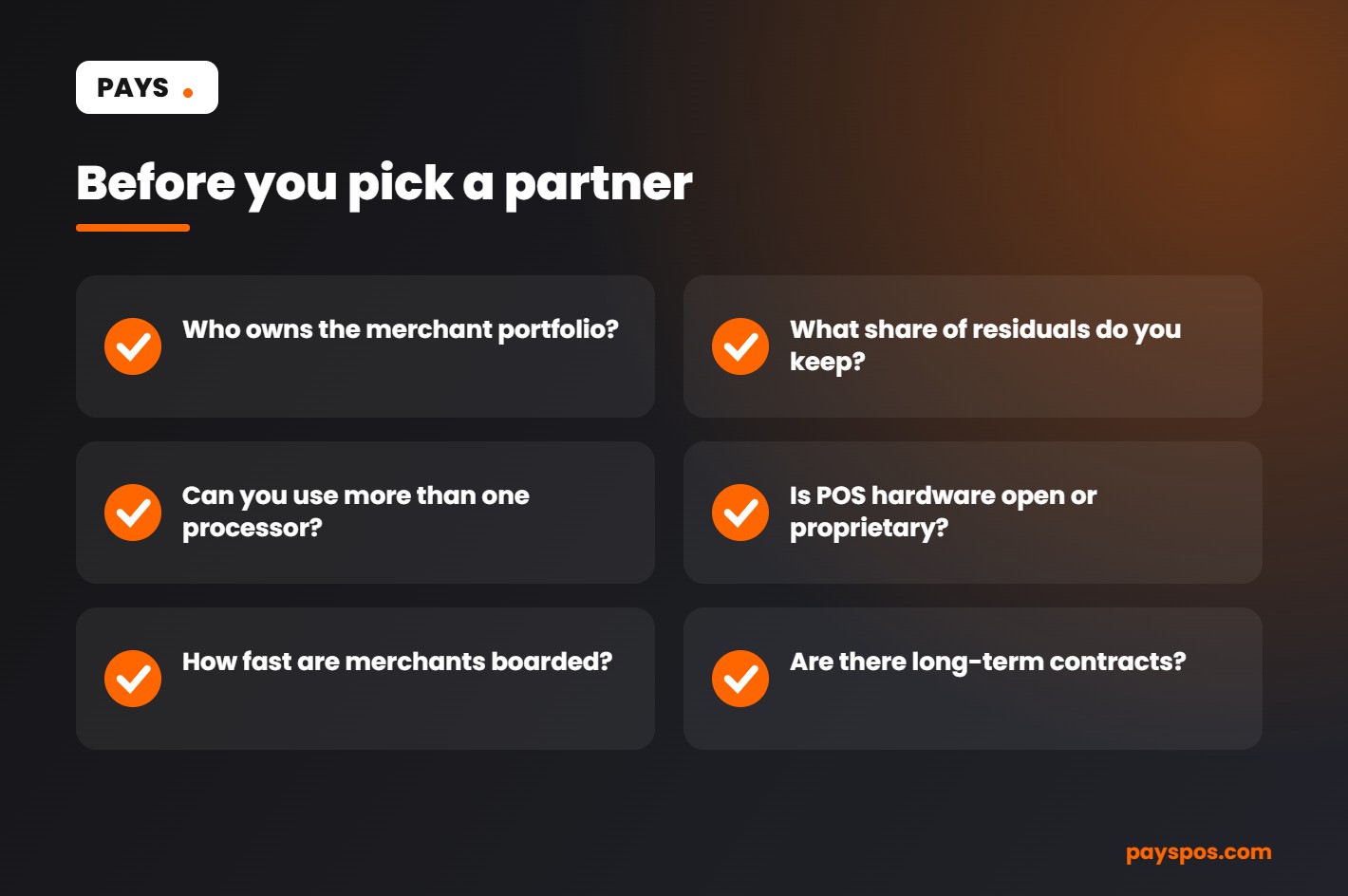
- Who owns the merchant portfolio, during and after the agreement?
- What percentage of processing revenue do you keep, and how is it calculated?
- Are there production minimums, vesting rules or clawbacks?
- Can you board merchants with more than one processor?
- Is the hardware open, or only usable with one provider?
- How quickly are merchants approved, set up and trained?
- What sales tools, CRM and support do you get?
- Are there long-term contracts for you or your merchants?
How Successful Resellers Grow Beyond Residuals
Residuals are the foundation, but the strongest sales organizations build several income streams on top of them. Once the ISO vs MSP question is settled and you’ve chosen a partner, look for ways to add value to every merchant you sign:
- POS software and hardware. A full POS deal is worth more than a merchant account alone, and it keeps the merchant with you longer.
- Dual pricing programs. Helping merchants offset card fees is one of the easiest conversations to start, and one of the most appreciated.
- Add-ons. Kiosks, kitchen displays, handhelds and online ordering grow the account over time.
- Referrals. Happy restaurant owners know other restaurant owners. A fast, smooth setup is your best referral engine.
The common thread is service. Merchants rarely leave a reseller who solves real problems for them quickly.
Questions Merchants Will Ask You
Whichever side of the ISO vs MSP label you end up on, merchants will judge you by how you answer a few simple questions:
- How much will this really cost me each month? Be ready to walk through fees clearly.
- Am I locked in? Merchants are wary of long contracts and proprietary hardware.
- How long until I’m up and running? Fast setup builds trust immediately.
- Who do I call when something breaks? Responsive, USA-based support is a strong selling point.
- Can it handle online orders and delivery apps? For restaurants, this is often the deciding factor.
A partner that helps you answer these well is worth more than any title on your business card.
Which Path Is Right for You?
Consider full ISO/MSP registration if you already have significant volume, a sales team, capital for reserves and fees, and the appetite to manage compliance and risk directly.
Consider a strong partner program if you want to grow residuals quickly, focus on selling rather than paperwork, and offer merchants a complete POS rather than processing alone.
In practice, ISO vs MSP matters far less here than volume and appetite for risk. Many successful sales organizations start as agents or sub-ISOs, build a portfolio, and only pursue their own registration once the numbers clearly justify it.
A Quick ISO vs MSP Glossary
- ISO: Independent Sales Organization, Visa’s term for a registered third-party seller of merchant accounts.
- MSP: Member Service Provider, Mastercard’s term for the same role. Also used loosely for any merchant services provider.
- Sponsor bank: The acquiring bank that registers an ISO/MSP with the card networks and holds responsibility for it.
- Sub-ISO: A sales organization working under a larger ISO’s registration.
- Agent: An individual or company selling under a partner’s registration and contract.
- Residuals: Ongoing monthly income from merchants’ processing volume.
- Buy rate: The cost a partner pays for processing, before adding its own margin.
- Attrition: Merchants leaving your portfolio. Lower attrition means more durable residuals.
Keep this glossary handy. Once these terms are clear, every ISO vs MSP pitch becomes much easier to evaluate.
Frequently Asked Questions
Is an ISO the same as an MSP?
In card-network terms, yes. ISO is Visa’s name and MSP (Member Service Provider) is Mastercard’s name for the same type of registered third-party sales organization. Many companies hold both registrations.
What does ISO/MSP mean?
ISO/MSP is shorthand for a company registered with both Visa (as an ISO) and Mastercard (as an MSP) through a sponsor bank, allowing it to sell and support merchant accounts.
Is MSP also short for merchant services provider?
Yes. Outside card-network rules, MSP is often used to mean any merchant services provider, including processors, POS companies and gateways. Context tells you which meaning is intended.
How much does it cost to become a registered ISO?
Costs vary by sponsor bank and network, but registration fees alone commonly run into the thousands of dollars per year, plus capital reserves, compliance and staffing.
What is the difference between an ISO and a payment processor?
A processor runs the technology that moves transactions. An ISO/MSP sells and supports merchant accounts on a processor’s platform and earns a share of processing revenue.
Can I sell merchant services without being a registered ISO?
Yes. Many resellers work as agents or sub-ISOs under a registered partner, which lowers cost and risk while still earning residuals.
What residual split should I expect?
It varies widely. Many traditional programs share around 30% to 50% of the margin. The Pays partner program lets partners keep 100% of their processing revenue.
Stop Comparing Labels. Start Comparing Partners.
The ISO vs MSP debate fades away once you know both terms describe the same registration. What remains is the decision that really matters: who owns your portfolio, how much you keep and what you can offer your merchants.
If you want full margin, open hardware and a POS merchants actually want, explore the Pays partner program or talk to our partner team.