
Cash may be a smaller share of sales than it used to be, but it is still where most register shortages, mistakes and internal theft happen. Clear cash handling procedures protect your money, protect honest employees from suspicion, and make every shift end the same way: counted, recorded and reconciled.
This guide walks through ten essential steps that work for restaurants, cafés, bars and retail stores, from the opening count to the bank deposit. It also covers how to keep cash consistent across several locations, and how your POS can do much of the checking for you.
Why cash handling procedures matter
Without written cash handling procedures, every manager handles cash a little differently. One counts the drawer at shift change, another does not. One records the safe drop, another forgets. When the deposit is short, nobody can say where the money went.
Good cash handling procedures do three things:
- Create accountability: every drawer, drop and deposit has a person and a time attached.
- Catch errors early: a short drawer found at the end of a shift is far easier to explain than one found at the end of the month.
- Deter theft: when employees know cash is counted and compared every shift, the temptation drops.
Clear cash handling procedures also make training easier. New staff follow the same steps from day one.
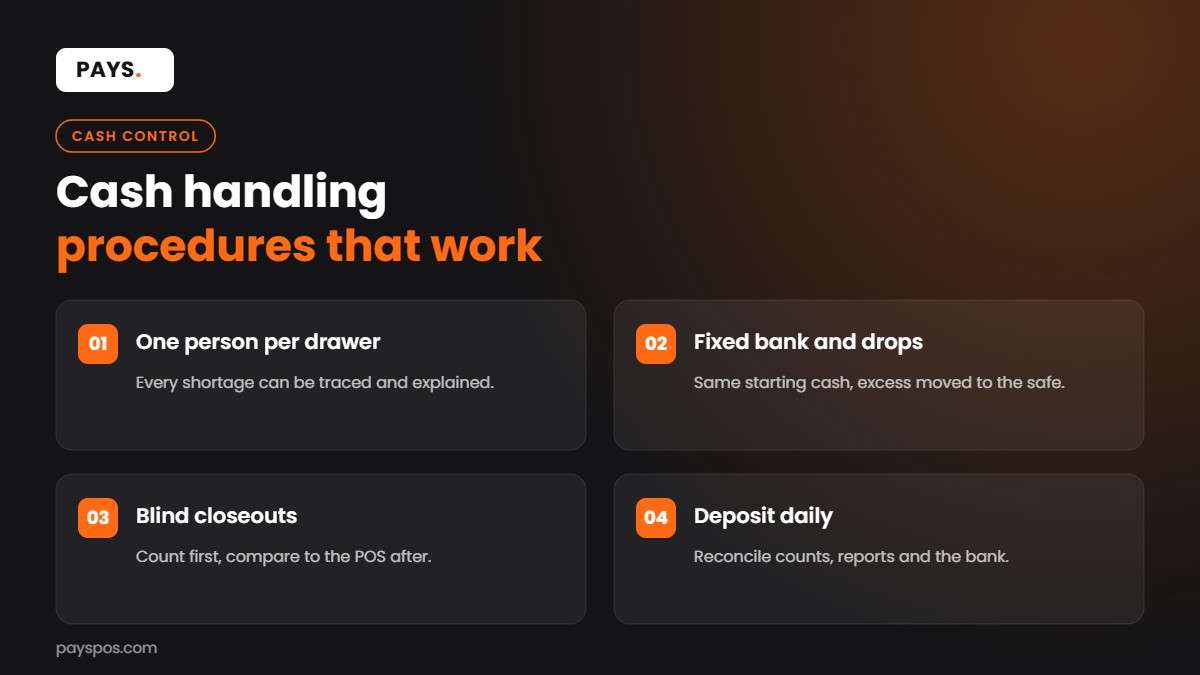
1. Assign one person to each drawer
The single most effective step in any set of cash handling procedures is simple: one cashier, one drawer, one shift. When several people share a drawer, a shortage cannot be traced to anyone, and honest employees end up under suspicion.
If your business truly needs shared drawers, such as a busy bar, make sure every transaction is rung under the employee’s own login so you can at least see who handled which sale.
2. Start every drawer with a fixed, counted bank
Each drawer should start with the same amount, called the starting bank or float, in a standard mix of bills and coins. A manager counts it, the cashier confirms it, and both sign off or confirm in the POS.
- Keep the starting amount the same every day, so differences stand out
- Use a standard breakdown, for example a set number of ones, fives, tens and rolled coins
- Record the count in the POS or on a drawer sheet before the first sale
3. Ring every sale through the POS
Every cash payment should go through the POS, with the drawer opening only to complete a sale. Cash taken without a sale being rung is the most common form of register theft, and it leaves no trace in the system.
Make it part of your cash handling procedures: no “no sale” drawer openings without a reason and a manager’s approval. Your POS can require a reason code and track how often each employee opens the drawer without a sale.
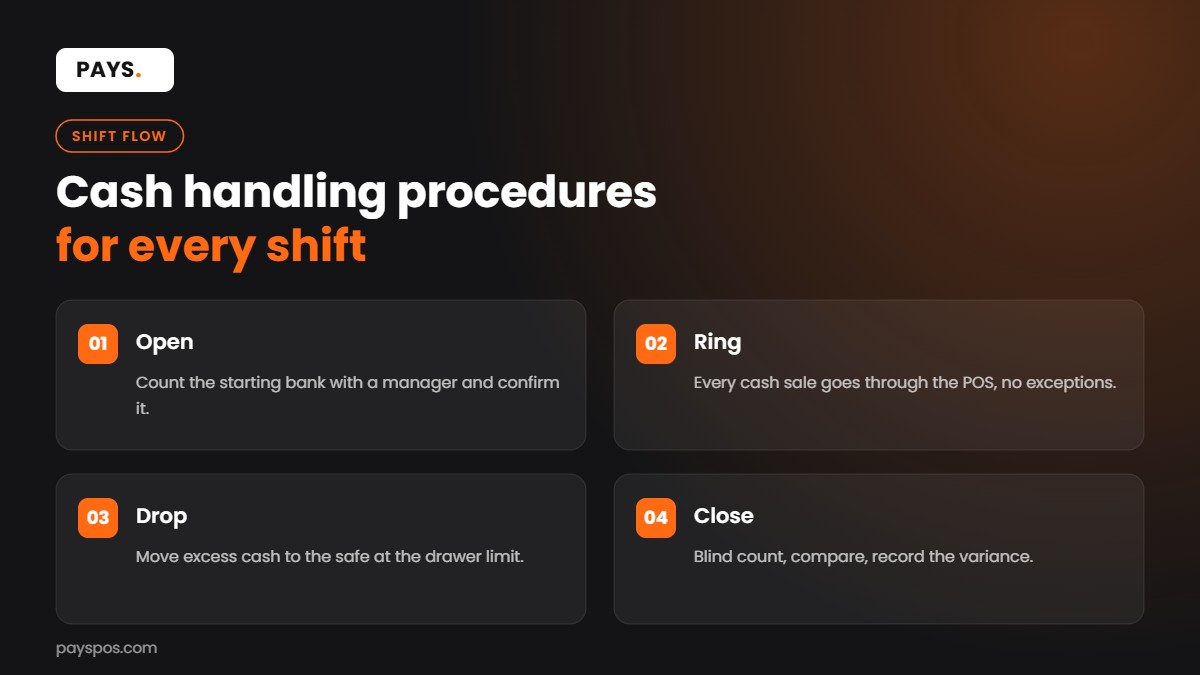
4. Limit cash in the drawer with safe drops
The more cash in an open drawer, the bigger the risk from robbery, mistakes and theft. Set a maximum amount for each drawer. When it is reached, a manager removes the excess and moves it to the safe.
- Count the drop in front of the cashier
- Record the amount, time and both names in the POS
- Seal drops in numbered bags if your bank or safe system uses them
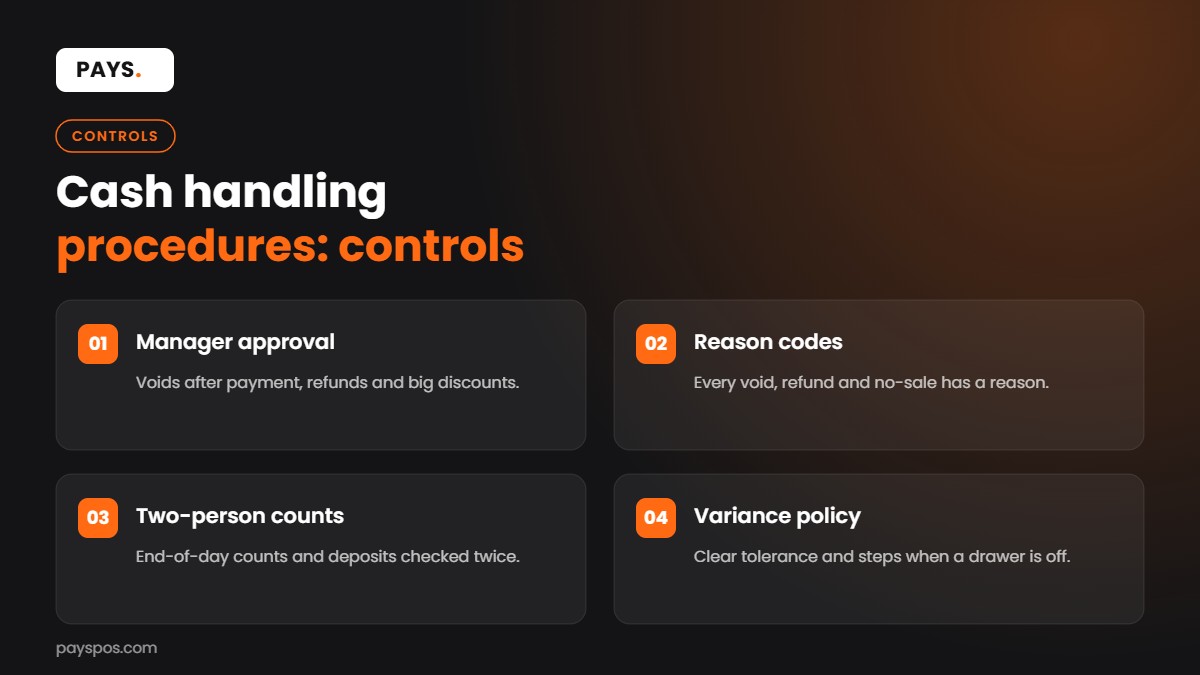
5. Control voids, refunds and discounts
Voids, refunds and discounts are legitimate tools, but they are also the easiest ways to hide missing cash. A cashier can ring a sale, take the cash, then void the sale. Protect against this by:
- Requiring manager approval for voids after payment, refunds and large discounts
- Requiring a reason for every void and refund
- Reviewing a void and refund report by employee every week
Patterns matter more than single events. One employee with far more voids than everyone else on the same shifts deserves a closer look.
6. Use blind closeouts
In a blind closeout, the cashier counts the drawer and enters the total without seeing what the POS expects. The system then compares the two. Because the cashier never sees the expected number, there is no temptation to make the count “match.”
Blind counts also give you honest data about how accurate each cashier is. Small, random overages and shortages are normal. Repeated shortages from the same person or shift are not.
7. Count with two people
For end-of-day counts and deposits, use two people whenever possible: the cashier and a manager, or two managers. Each counts independently, and both confirm the total. Two-person counts prevent mistakes and protect both employees if a question comes up later.
8. Set a clear variance policy
Decide in advance what counts as an acceptable difference between the expected and actual cash, and what happens when a drawer is outside it.
- Within tolerance: record it and move on
- Outside tolerance: recount, review the transactions and note the reason
- Repeated variances: retraining first, then further action according to your written policy
Check your state’s wage laws before making any policy about deducting shortages from pay. Many states restrict or prohibit it.
9. Deposit daily and reconcile
Cash sitting in a safe for days is cash at risk. Deposit every day if possible, and reconcile the deposit against your POS reports.
- Prepare the deposit slip from the counted cash, not from the POS report
- Record the deposit amount and who took it to the bank
- Match the bank’s record to your deposit within a day or two
- Investigate any difference right away
If your business ever receives more than $10,000 in cash in one transaction or related transactions, the IRS generally requires you to file Form 8300. This is rare for most restaurants and shops, but it matters for large catering orders and event bookings paid in cash.
10. Review reports every week
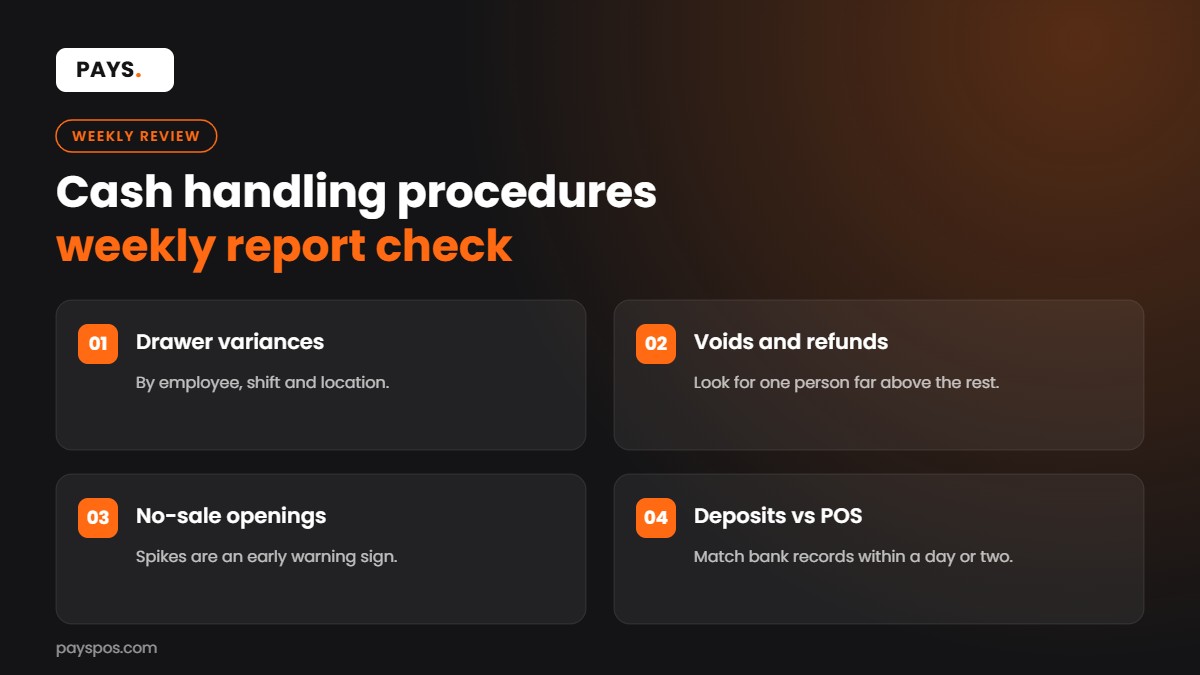
Cash handling procedures only work if someone checks them. Set aside time each week to review:
- Drawer variances by employee and shift
- Voids, refunds and discounts by employee
- No-sale drawer openings
- Cash sales as a share of total sales, by day and location
- Deposits versus POS cash totals
A sudden drop in cash sales at one location, while card sales stay steady, can be an early warning sign that cash is not being rung in.
Cash handling procedures across multiple locations
Every location should follow the same written cash handling procedures, with the same starting bank, drop limits and approval rules. A cloud POS makes it possible to compare locations side by side:
- Variance rates by location and manager
- Void and refund rates compared with sales volume
- Cash share of sales, which should be fairly stable for similar stores
- Deposit timing, to catch locations that hold cash too long
When one location stands out, visit it, watch a closeout and retrain where needed. Our multi-store POS page shows how PAYS brings these reports together for owners with several sites.
Hardware that supports your cash handling procedures
A sturdy, locking cash drawer connected to the POS, which opens only when a sale is completed, is the base of any cash procedure. Our cash register drawer buying guide covers what to look for, from bill slots to lock types. Add a drop safe in a back office and a camera that covers each register for a complete setup.
Cash handling procedures: real-world scenarios
The café with a weekly shortage
A café’s deposits are short by small amounts most weeks. The owner switches to one cashier per drawer and blind closeouts. Within two weeks, the variances point to a single shift where two people had been sharing a drawer. A clear rule and some retraining fix the problem.
The bar with too many no-sales
A bar owner reviews the no-sale report and finds one bartender opens the drawer far more often than others. The POS now requires a reason and a manager code for each no-sale. The count drops, and the bar’s cash share of sales goes back up.
The three-store retailer
A retailer compares cash share of sales across three stores. One store is much lower than the others, even though its customers are similar. A closer look at refunds shows a pattern of cash refunds without receipts. Requiring manager approval for those refunds closes the gap.
Glossary
- Starting bank (float): the fixed amount of cash placed in a drawer at the start of a shift.
- Safe drop: removing excess cash from a drawer during a shift and placing it in a safe.
- Blind closeout: counting a drawer without seeing the expected total first.
- Variance: the difference between expected and counted cash.
- No sale: opening the drawer without completing a transaction.
- Reconciliation: matching cash counts, POS reports and bank deposits.
How to write cash handling procedures for your business
The best cash handling procedures fit on one or two pages and use plain language. Staff should be able to read them in five minutes and follow them on a busy Friday without asking a manager.
Start with your current routine
Watch a full shift, from opening count to closing deposit, and write down what actually happens. Most owners find a few gaps right away, such as drawers shared during breaks or drops that are never recorded. Your new cash handling procedures should close those gaps first.
Write one step per line
Use short, numbered steps: count the starting bank, confirm it in the POS, ring every sale, call a manager at the drop limit, close out blind, count the deposit with two people. Numbered cash handling procedures are easier to train and easier to check.
Name who does what
For every step, say which role is responsible: cashier, shift lead or manager. Cash handling procedures that leave ownership vague tend to be skipped when the store is busy.
Set your numbers
Write down the starting bank amount, the maximum drawer amount before a drop, the variance tolerance and the deposit schedule. Keep these numbers the same at every location so reports can be compared.
Train, sign and review
Walk every new hire through the cash handling procedures on day one and keep a signed acknowledgment. Review the document every six months, or sooner if reports show a new problem. Cash handling procedures that are updated as the business changes stay useful for years.
Keep your cash handling procedures visible
Post a one-page summary of your cash handling procedures in the back office, next to the safe, and keep the full version in your training folder. When a question comes up mid-shift, staff can check the steps in seconds instead of guessing.
Cash handling procedures and your team culture
Cash handling procedures are not about distrusting staff. Most employees are honest, and clear rules protect them from being blamed for someone else’s mistake. Explain that to the team when you introduce new cash handling procedures. Share the reasons behind each step, invite questions, and recognize shifts that close out perfectly. When people understand that cash handling procedures protect everyone, they follow them more consistently, and shortages become rare.
A one-week cash audit
Not sure where your cash problems start? Run a one-week audit. Count every drawer at every shift change, record every safe drop, and compare each deposit with the POS report the same day. Note who handled each drawer and any differences. At the end of the week, the pattern is usually obvious: one shift, one register or one step that keeps going wrong. Fix that step first, update your written procedures, and repeat the audit a month later to confirm the change worked.
Cash is only one source of loss. See how POS integrations reduce shrinkage across inventory too.
Key takeaways
- One cashier per drawer is the most effective cash control.
- Fixed starting banks, safe drops and daily deposits limit risk.
- Blind closeouts and two-person counts produce honest numbers.
- Manager approval on voids, refunds and no-sales closes common gaps.
- Weekly reports, compared across shifts and locations, catch problems early.
Cash handling procedures by business type
The core steps stay the same everywhere, but cash handling procedures work best when they fit the way your business actually takes payments.
Quick-service restaurants and cafés
Counter service means many small cash sales and lots of change. Keep the starting bank weighted toward ones, fives and coins, and set a lower drop limit because drawers fill quickly at lunch. Cash handling procedures for cafés should also cover the tip jar, so it is counted and shared on a set schedule.
Full-service restaurants
Servers often carry cash during a shift and settle up at the end. Your cash handling procedures should explain how servers turn in cash, how cash tips are declared, and how the server’s checkout report is matched against what they hand in.
Bars
Bars are fast, loud and often share registers. Assign drawers per bartender where possible, require reason codes on no-sales, and review the void report after every busy night. Strong cash handling procedures matter most where speed makes mistakes easy.
Retail stores
Retail adds cash refunds and exchanges. Require a receipt or manager approval for cash refunds, and limit refunds to the original payment method. Retail cash handling procedures should also cover petty cash, which is often where small losses hide.
Food trucks and pop-ups
Mobile businesses deposit less often and carry cash between locations. Use a locked cash box, count at the end of each service with two people when possible, and deposit as soon as you can. Simple cash handling procedures keep a mobile business safe on the road.
Signs your cash handling procedures need an update
- Drawer variances keep appearing on the same shift or location.
- Managers handle closeouts differently from one another.
- Cash sales drop while card sales stay steady.
- Deposits are late or do not match POS reports.
- New hires are not trained on cash steps in their first week.
If two or more of these sound familiar, review your cash handling procedures, retrain the team and watch the reports closely for the next month.
Frequently Asked Questions
What are basic cash handling procedures?
Assign one person per drawer, start with a fixed counted bank, ring every sale, make safe drops, require approval for voids and refunds, close out blind, count with two people and deposit daily.
What is a blind closeout?
The cashier counts the drawer and enters the total without seeing what the POS expects. The system compares the two and records the variance.
How much cash should be in a register drawer?
Enough to make change for a normal shift, set as a fixed starting bank. Set a maximum, and move excess cash to the safe with a recorded drop when it is reached.
How can a POS reduce cash theft?
By tying every transaction to an employee login, requiring approval for voids and refunds, tracking no-sale openings and reporting variances by employee, shift and location.
Can I deduct cash shortages from an employee’s pay?
It depends on your state. Many states restrict or prohibit it, and it can affect minimum wage compliance. Check with your state labor department or an employment attorney first.
Keep every drawer accountable with PAYS
PAYS ties every sale, void and drawer opening to an employee, supports blind closeouts and safe drops, and shows cash reports across all your locations. Book a free demo to see how PAYS can tighten cash handling in your business.