
The new no tax on tips deduction is the biggest payroll change tipped restaurants have seen in years. Servers and bartenders are asking about it every shift, and owners are being asked questions they never had to answer before: Which of my staff qualify? Does an automatic gratuity count? What do I put on the W-2? This guide explains how no tax on tips works, what changes for employers in 2026, and the nine steps to get your payroll and POS ready before the first new-style W-2s go out.
A quick note before we start: this article is general information for restaurant owners and managers, not tax or legal advice. Rules and IRS instructions can change, so confirm the details for your business with your payroll provider or a tax professional.
What is no tax on tips?
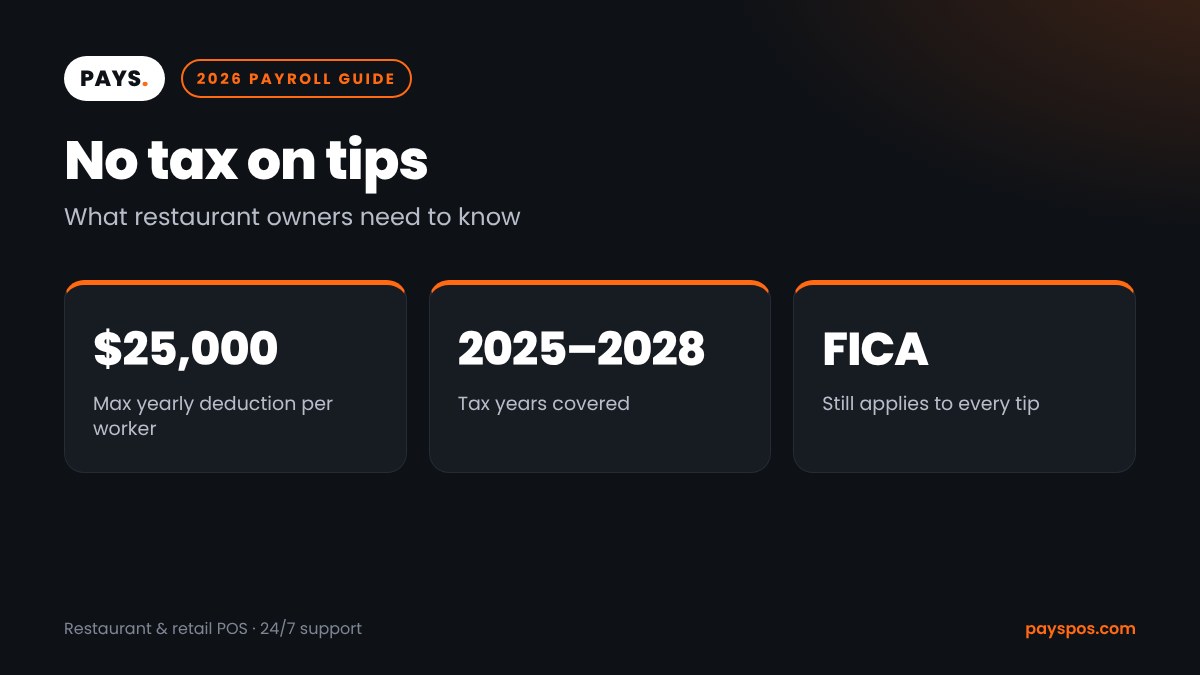
No tax on tips is a federal income tax deduction created by the One Big Beautiful Bill Act, signed on July 4, 2025. It lets eligible workers deduct up to $25,000 of qualified tips from their federal taxable income each year. The deduction applies to tax years 2025 through 2028, and workers can claim it whether or not they itemize.
The deduction phases out for higher earners. It is reduced by $100 for every $1,000 of modified adjusted gross income above $150,000 for single filers, or $300,000 for joint filers. For the vast majority of servers, bartenders and bussers, the full deduction is available.
The IRS published final regulations in April 2026. They confirmed the list of qualifying occupations, the definition of a qualified tip and the new reporting rules for employers. You can read the official overview on the IRS page for working Americans and seniors.
What no tax on tips does not change
This is the part many employees misunderstand. No tax on tips is an income tax deduction only. It does not remove:
- Social Security and Medicare (FICA) taxes on tips. Employees still owe their share and you still owe yours.
- State income taxes. Some states follow the federal deduction and some do not.
- Tip reporting duties. Employees must still report tips to you, and you must still withhold and report as before.
- Your FICA tip credit. The existing employer credit for Social Security and Medicare paid on tips is a separate rule and still applies.
When a server says “tips aren’t taxed anymore,” the accurate answer is that most of their tips may be deductible from federal income tax when they file, but payroll taxes still apply on every paycheck.
Who qualifies for no tax on tips?
Only workers in occupations that “customarily and regularly” received tips before 2025 qualify. Treasury published an exhaustive list of more than 70 occupations, each with a three-digit Treasury Tipped Occupation Code (TTOC). If a job is not on the list, its tips do not qualify for no tax on tips, even if the worker earns tips.
For restaurants, the good news is that the food and beverage service category is broad. It includes roles such as:
- Bartenders
- Wait staff and food servers
- Dining room attendants and bartender helpers (bussers and barbacks)
- Host staff
- Chefs, cooks and food preparation workers who receive tips
- Fast food and counter workers
- Dishwashers
- Bakers
Two groups need extra care. First, owners: if the person receiving the tip owns 5% or more of the business paying them, those tips are treated as wages and do not qualify. Second, workers who split their time between a tipped role and a non-tipped role, such as a server who also does office work, need their tips tracked by role.
The specified service business exception
The law excludes workers whose employer is a “specified service trade or business,” such as health, law or consulting firms. Restaurants and bars are not in that group, and the IRS has said it will not enforce this exclusion until separate rules are finalized. For a normal restaurant, cafe or bar, this exception does not apply.
What counts as a qualified tip?
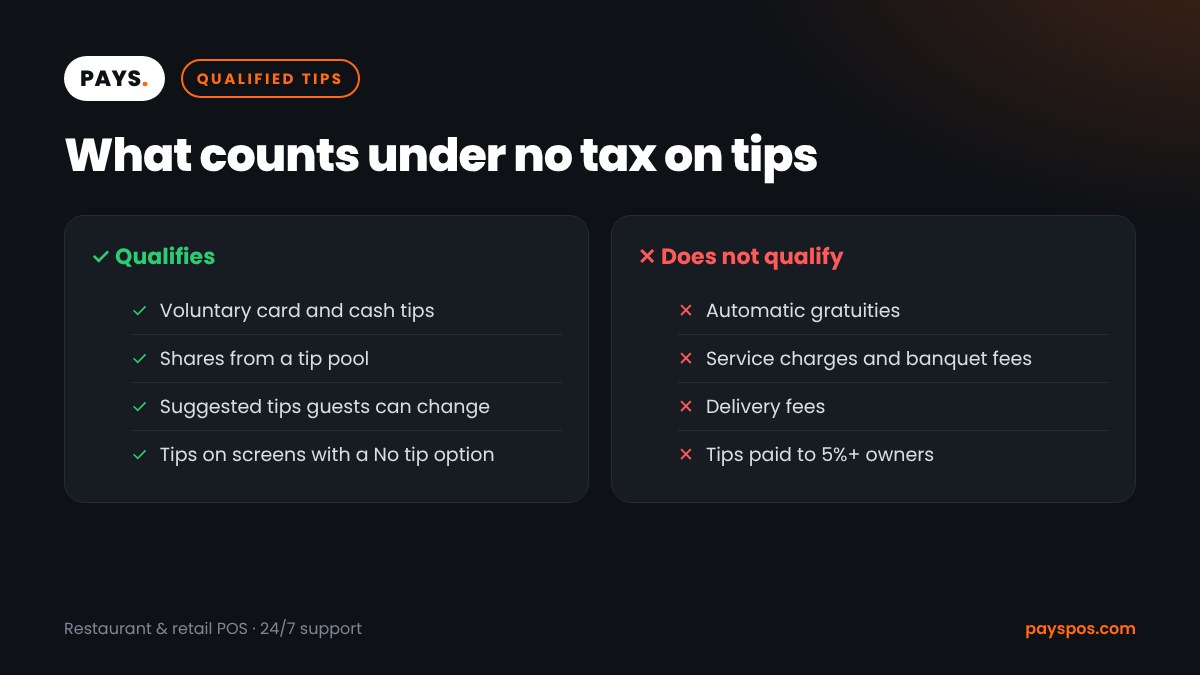
This is where your POS settings matter most. Under no tax on tips, a qualified tip must be paid voluntarily by the customer, with the amount decided by the customer and not negotiated. Tips can be paid in cash, by card, by check, with a gift card or through a mobile payment.
These do not count as qualified tips:
- Service charges added by the restaurant
- Mandatory automatic gratuities, such as an 18% charge on parties of eight or more
- Event and banquet fees set in a contract
- Non-cash items, such as free meals or tickets
Tips that go through a tip pool can still qualify, whether the pool is voluntary or mandatory, as long as the money started as a voluntary customer tip.
The tip screen rule every counter-service owner should know
The final rules include a detail that directly affects tablet and kiosk tipping. If your payment screen offers a “no tip” option, any tip the customer chooses counts as voluntary. If your screen does not offer a “no tip” option, only the amount above the lowest required percentage counts as a qualified tip.
A modifiable “suggested tip” still qualifies. A non-negotiable charge placed on the tip line does not. For most restaurants, the fix is simple: make sure every tip prompt includes a clear “No tip” or “Custom” button.
Automatic gratuities: the biggest no tax on tips trap
Many full-service restaurants add an automatic gratuity for large parties. Under no tax on tips, that money is a service charge, not a tip. It is wages for tax purposes, it does not qualify for the deduction, and it should be reported as wages, not tips.
That leaves owners with a choice. You can keep the automatic charge and tell staff it will not qualify. Or you can replace it with a printed suggested tip, for example “Suggested gratuity for parties of 8 or more: 18%,” and let the guest decide. Many restaurants are switching to the second option because servers ask for it once they understand no tax on tips.
If you keep automatic gratuities, ring them as a separate service charge in your POS so they never mix with voluntary tips in your reports.
What employers must report starting in 2026
For 2025, employers did not have to change their W-2 forms. Many restaurants gave employees an optional statement of tips received to help them claim the deduction.
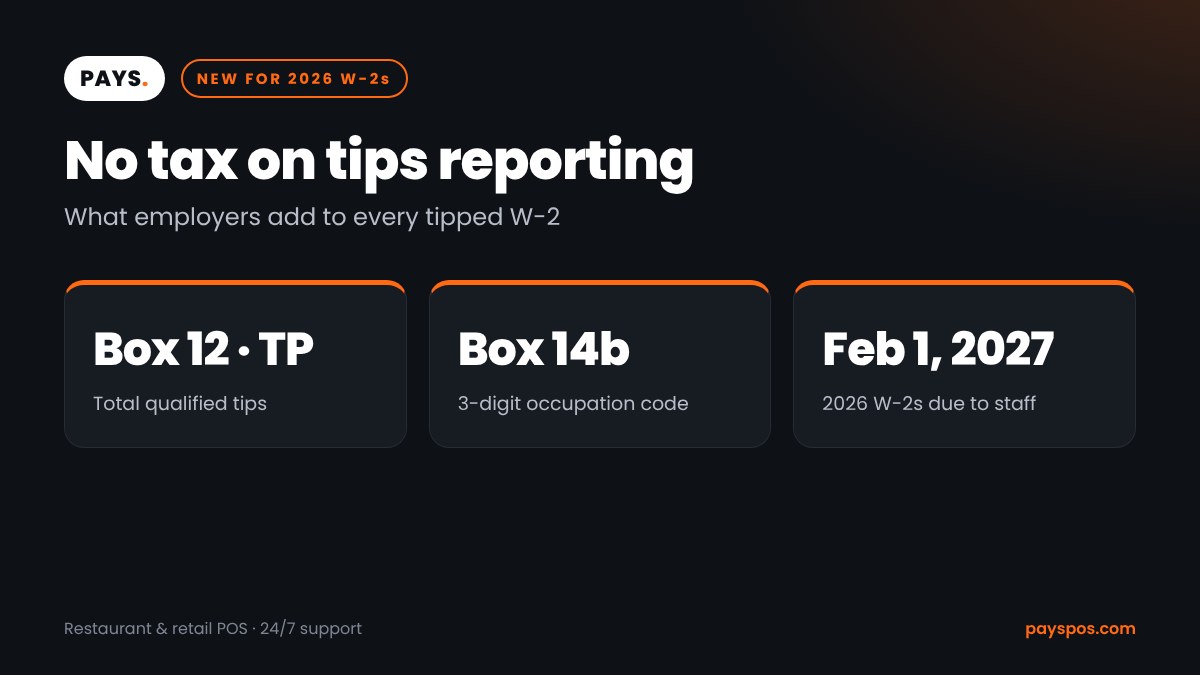
Starting with 2026 wages, the W-2 changes. The 2026 forms are due to employees by February 1, 2027, and they include two new items:
| W-2 item | What goes in it |
|---|---|
| Box 12, code TP | Total qualified tips the employee received in 2026 |
| Box 14b | The employee’s three-digit TTOC occupation code (up to two codes) |
| Code 000 in box 14b | Used when tips came from a non-qualifying occupation |
Contractors who receive qualified tips are reported on Form 1099-MISC, 1099-NEC or 1099-K in new boxes. Most restaurants only deal with W-2 employees, but caterers and event businesses that use contractors should check this too.
Your payroll provider will likely handle the form itself. What they cannot do is invent data you never collected. If your POS does not separate voluntary tips from service charges, or does not know which job each employee worked when they earned a tip, your 2026 W-2s will be wrong.
No tax on tips: 9 steps for restaurant owners
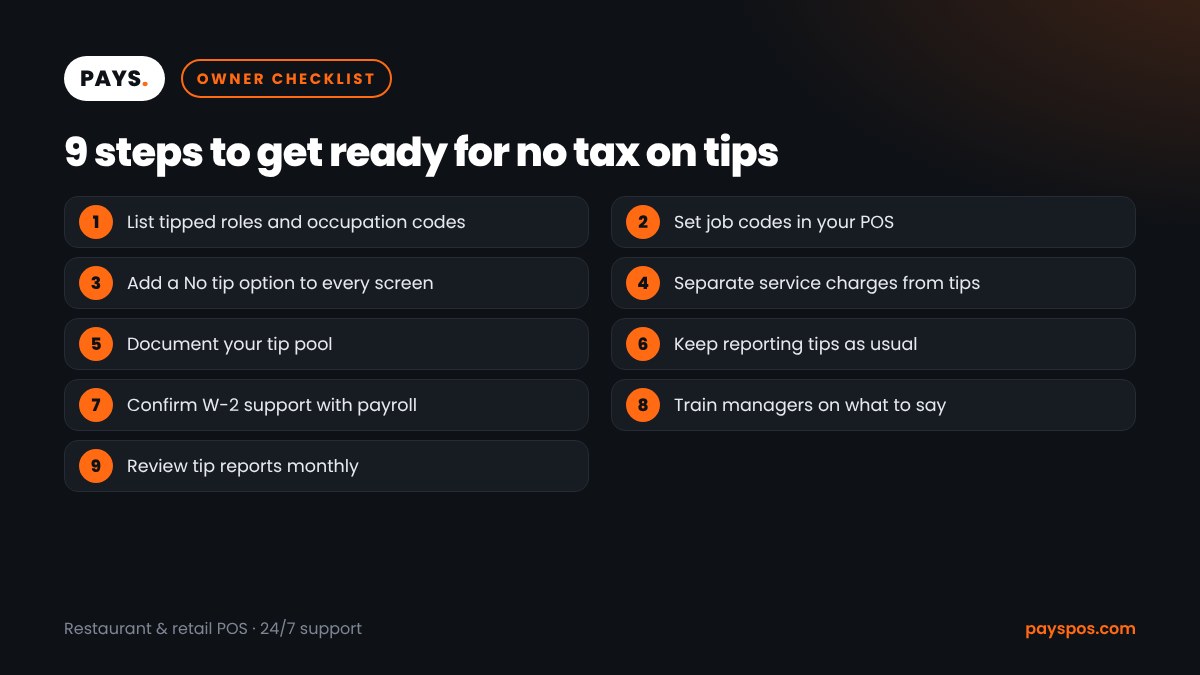
Here is a practical checklist to get ready. Most of it can be done in a single afternoon with your manager and your POS settings open.
1. List every tipped role and its occupation code
Write down each job that receives tips, such as server, bartender, busser, host and barback. Match each to its occupation on the official list. Flag any role that is not on the list, because its tips will need code 000.
2. Set up job codes in your POS
Every employee who works more than one role should clock in under the right job each shift. When a bartender covers a server shift, the tips from that shift belong to the server role. Clean job codes make no tax on tips reporting accurate.
3. Add a “No tip” option to every tip screen
Check every tipping screen: handhelds, countertop terminals, kiosks and online ordering. Each should offer a no-tip or custom option. Without it, part of your staff’s tips may not qualify.
4. Separate service charges from tips
Move automatic gratuities, banquet fees and delivery fees into service charge categories. Your sales and payroll reports should show them separately from voluntary tips.
5. Document your tip pool
Write down who is in the pool, how points or percentages are set and who manages the split. Keep managers and owners with 5% or more ownership out of the pool. A clear policy protects you under both wage laws and no tax on tips.
6. Keep reporting tips the usual way
Employees should still report cash tips to you by the 10th of the following month, and you should still include tips in payroll and withhold FICA. Nothing about no tax on tips removes these duties.
7. Talk to your payroll provider now
Ask three questions: Do you support box 12 code TP and box 14b? Can you import tips by job code from our POS? When do you need our tip data each pay period?
8. Train managers on what to say
Give managers a short script. Something like: “No tax on tips may let you deduct most of your tips from federal income tax when you file. Payroll taxes still apply, and service charges don’t count.” This avoids promises you cannot keep.
9. Review your reports monthly
Do a quick monthly check of tips by employee, by role and by type. Fixing a coding mistake in March is easy. Fixing twelve months of mistakes in January is not.
How your POS should handle no tax on tips
Your point of sale system is where tip data is born. If the data is clean there, payroll is easy. If it is messy, no amount of payroll software will fix it. Here is what to look for:
- Tips recorded per check and per employee, including split checks and transferred tables
- Job codes tied to each shift, so tips follow the role
- Separate categories for voluntary tips, automatic gratuities and service charges
- Customizable tip screens with a no-tip option on every device
- Tip pool tools that calculate shares by hours or points
- Exportable reports your payroll provider can import without retyping
If you want a deeper look at tip tracking, our guide on managing employee tips and payroll covers the daily side. Card fees on tips also add up, so it is worth reviewing your restaurant processing fees while you are in your settings.
Real-world scenarios
A full-service restaurant with a tip pool
A 90-seat bistro pools 100% of card tips and shares them by hours among servers, bussers and bartenders. All three roles are on the occupation list, so the pooled tips qualify. The owner sets job codes in the POS, removes the general manager from the pool and keeps the 20% large-party charge as a separate service charge. At year end, payroll pulls qualified tips per employee straight from the POS export.
A busy cocktail bar with automatic gratuity on tabs
A bar adds an automatic 20% gratuity to every open tab. Under no tax on tips, none of that money qualifies, which frustrated the bartenders. The owner switched to a suggested tip line with a no-tip option. Most guests still tip 20% or more, and now those tips count as qualified.
A counter-service cafe with tablet tipping
A coffee shop’s tablet offers 15%, 20% and 25% buttons but no “No tip” button. Under the final rules, only the amount above 15% counts as qualified. Adding a no-tip button fixed it in two minutes.
An owner who works the floor
A co-owner with 30% of the business bartends on weekends and receives tips. Because the owner holds more than 5%, those tips are treated as wages and do not qualify. The owner should be kept out of the tip pool and paid separately.
Using no tax on tips to hire and keep staff
Hiring is still hard for most restaurants, and no tax on tips gives you a real talking point. A server earning $30,000 a year in tips could deduct $25,000 of those tips from their federal taxable income, the maximum allowed. That can mean a bigger refund or a smaller tax bill when they file.
Mention no tax on tips in job posts for tipped roles, explain it in onboarding, and show new hires how your POS tracks their tips by shift. Staff who can see accurate tip records trust the system, and they stay longer. Just keep the message accurate: payroll taxes still apply, and only voluntary tips count.
Common no tax on tips mistakes to avoid
- Telling staff tips are now “tax-free” without mentioning FICA and state taxes
- Counting automatic gratuities as qualified tips
- Using tip screens with no “No tip” option
- Letting managers or owners take a share of the tip pool
- Waiting until January 2027 to find out your POS cannot report tips by job
- Mixing delivery fees or service charges into tip totals
No tax on tips glossary
- Qualified tip: A voluntary cash or card tip from a customer, in an occupation on the official list.
- TTOC: Treasury Tipped Occupation Code, the three-digit code that goes in W-2 box 14b.
- Code TP: The new W-2 box 12 code for qualified tips.
- Service charge: A mandatory fee added by the business. It is wages, not a tip.
- Tip pool: A shared fund of tips split among eligible staff.
- FICA tip credit: An employer tax credit for Social Security and Medicare taxes paid on tips.
- Phase-out: The income level above which the deduction gets smaller.
Before you finish your setup, it also helps to review your labor compliance setup, since tip policies and scheduling rules often overlap.
Key takeaways
- No tax on tips lets eligible workers deduct up to $25,000 of qualified tips from federal income tax for 2025 through 2028.
- FICA taxes, state taxes and tip reporting duties still apply.
- Service charges and automatic gratuities do not qualify. Voluntary tips, including pooled tips, do.
- Every tip screen should include a “No tip” option.
- 2026 W-2s need box 12 code TP and box 14b occupation codes, due February 1, 2027.
- Clean POS data, with tips by employee, by job and by type, is the foundation of correct reporting.
Frequently Asked Questions
Does no tax on tips mean tips are completely tax-free?
No. No tax on tips is a federal income tax deduction of up to $25,000. Social Security and Medicare taxes still apply, and state income tax may still apply depending on where you live.
Do automatic gratuities count under no tax on tips?
No. A mandatory automatic gratuity is a service charge, so it is treated as wages. A suggested tip that the guest can change or remove does count as a voluntary tip.
Do pooled tips qualify?
Yes. Tips shared through a voluntary or mandatory tip pool can qualify, as long as they started as voluntary customer tips and go to workers in qualifying occupations.
What do restaurant employers need to report?
For 2026 wages, employers report qualified tips in W-2 box 12 with code TP and the employee’s occupation code in box 14b. Forms are due to employees by February 1, 2027.
Can restaurant owners claim the deduction on their own tips?
Generally no. If the person receiving tips owns 5% or more of the business that pays them, the tips are treated as wages and do not qualify for no tax on tips.
Get your tips ready with PAYS
PAYS POS tracks tips by employee, by job and by type, separates service charges from voluntary tips and exports clean reports your payroll provider can use for 2026 W-2s. Tip screens on our handhelds, terminals and kiosks include a no-tip option by default. Book a free demo at payspos.com and get your no tax on tips setup right before year end, with 24/7 support whenever you need it.