
A guest enjoys dinner, pays by card, leaves a tip and goes home happy. Six weeks later, the money disappears from your account. The guest’s bank has reversed the charge, and you’re left with a fee, a lost sale and a deadline to respond.
Restaurant chargebacks are one of the most frustrating costs in the business. They often arrive long after the meal, they come with fees whether you win or lose and the rules can feel stacked against the merchant. Yet many restaurant chargebacks are preventable, and many of the rest can be won with the right records.
This guide explains how restaurant chargebacks work, the 9 costly mistakes that cause them and simple steps to stop losing money on disputes.
Restaurant Chargebacks at a Glance
- Restaurant chargebacks pull money back from your account and usually add a fee.
- Many restaurant chargebacks come from preventable issues like unclear statement names and tip errors.
- Fast responses with clear evidence win more restaurant chargebacks.
- Modern terminals and tableside payment help prevent restaurant chargebacks.
What Is a Chargeback?
A chargeback happens when a cardholder disputes a transaction with the bank that issued their card, and the bank reverses the payment. The money is pulled back from the merchant’s account while the dispute is reviewed. If the merchant doesn’t respond in time, or the evidence isn’t strong enough, the reversal usually stands.
Chargebacks exist to protect consumers from fraud and errors. Cardholders can also dispute charges under consumer protection rules, and the Federal Trade Commission explains those rights for consumers. For restaurants, the process can be painful when a guest disputes a charge they actually made.
Why Restaurant Chargebacks Hurt So Much
The cost of restaurant chargebacks goes beyond the amount of the bill:
- The lost sale: the food was served and eaten, but the money is gone.
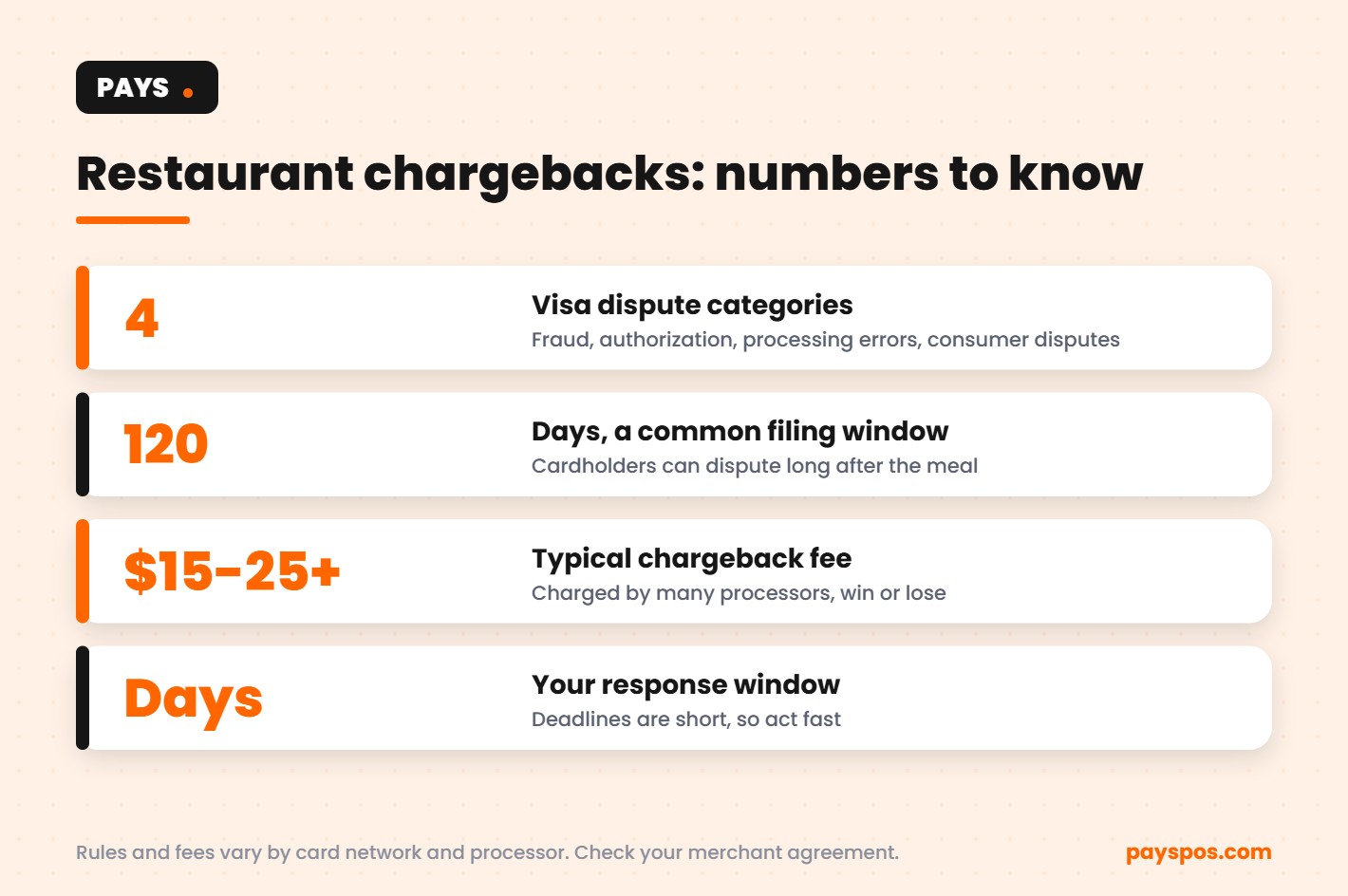
- Chargeback fees: many processors charge a fee per dispute, often around $15 to $25 or more.
- Staff time: finding receipts and writing responses takes hours.
- Account risk: a high chargeback ratio can lead to extra monitoring, fines or even losing your merchant account.
For a restaurant running on thin margins, even a handful of disputes a month can erase the profit from many tables.
How the Chargeback Process Works
Although details vary by card network and processor, most restaurant chargebacks follow a similar path:
- The cardholder contacts their bank to dispute a charge.
- The bank reviews the claim and assigns a reason code.
- The funds are pulled from your account, and your processor notifies you.
- You accept the chargeback or respond with evidence before the deadline.
- The issuing bank reviews your evidence and decides the outcome.
Cardholders often have up to 120 days or longer to dispute a charge, depending on the situation. Merchants, on the other hand, usually get a much shorter window to respond, and your processor may set an even earlier internal deadline. Missing it typically means losing the dispute automatically.
The Four Types of Disputes
Visa groups disputes into four categories, and other networks use similar ideas:
- Fraud: the cardholder says they didn’t make or authorize the purchase.
- Authorization: the transaction wasn’t properly approved, or the approved amount didn’t match.
- Processing errors: duplicate charges, wrong amounts or late processing.
- Consumer disputes: the guest says they didn’t receive what they paid for or were unhappy with it.
The category matters because it decides what evidence you need. A fraud claim needs proof the card and cardholder were present. A processing error claim needs proof the amount was correct and charged once.
9 Costly Mistakes That Cause Restaurant Chargebacks
1. A business name guests don’t recognize
If your card statement shows a legal company name instead of your restaurant’s name, guests may not recognize the charge and dispute it as fraud. Make sure your statement descriptor clearly shows the name people know, and ideally your city or phone number.
2. Tip adjustment problems
Restaurants often authorize the bill amount, then add the tip later. If the final amount doesn’t match what the guest approved, or a tip is entered incorrectly, it can trigger an authorization or processing error dispute. Train staff to enter tips carefully and keep tip receipts.
3. Duplicate charges
A card that seems to fail, then gets run again, can lead to two charges for one meal. Guests spot it on their statement and dispute both. Check your POS before re-running a card and void any accidental duplicates the same day.
4. Swiping instead of dipping or tapping
Since October 2015, liability for certain counterfeit card fraud in the US has generally shifted to the party with the less secure technology. If a guest presents a chip card and the payment is swiped on an outdated terminal, you may be responsible for that fraud. Use EMV chip and contactless-ready terminals for every in-person payment.
5. Taking cards out of sight
When a server walks away with a guest’s card, it creates opportunities for fraud and makes guests nervous. Paying at the table on a handheld keeps the card in the guest’s hand and creates a clear record of the transaction.
6. Weak online and phone order checks
Card-not-present orders, such as online and phone orders, carry more fraud risk than in-person payments. Watch for very large orders, unusual delivery addresses and repeated failed card attempts. Use the fraud tools your processor offers.
7. Delivery orders with no proof
A guest who says their delivery never arrived may file a dispute. Keep records of order time, delivery confirmation and any messages with the guest. For pickup orders, record when the order was handed over.
8. Ignoring unhappy guests
Some restaurant chargebacks start as complaints that nobody handled. A guest who feels ignored may go to their bank instead. Train managers to resolve complaints quickly, and offer a fair refund or credit when something truly went wrong.
9. Poor record keeping
You can’t win a dispute if you can’t find the evidence. Paper receipts get lost, and tickets get thrown away. A POS that stores itemized receipts, order tickets and payment details makes it easy to pull records weeks later.
How to Respond to Restaurant Chargebacks
When a dispute arrives, act quickly:
- Read the reason code. It tells you what the guest claimed and what evidence matters.
- Decide whether to fight. If the guest is right, such as a duplicate charge, accepting may be the better choice.
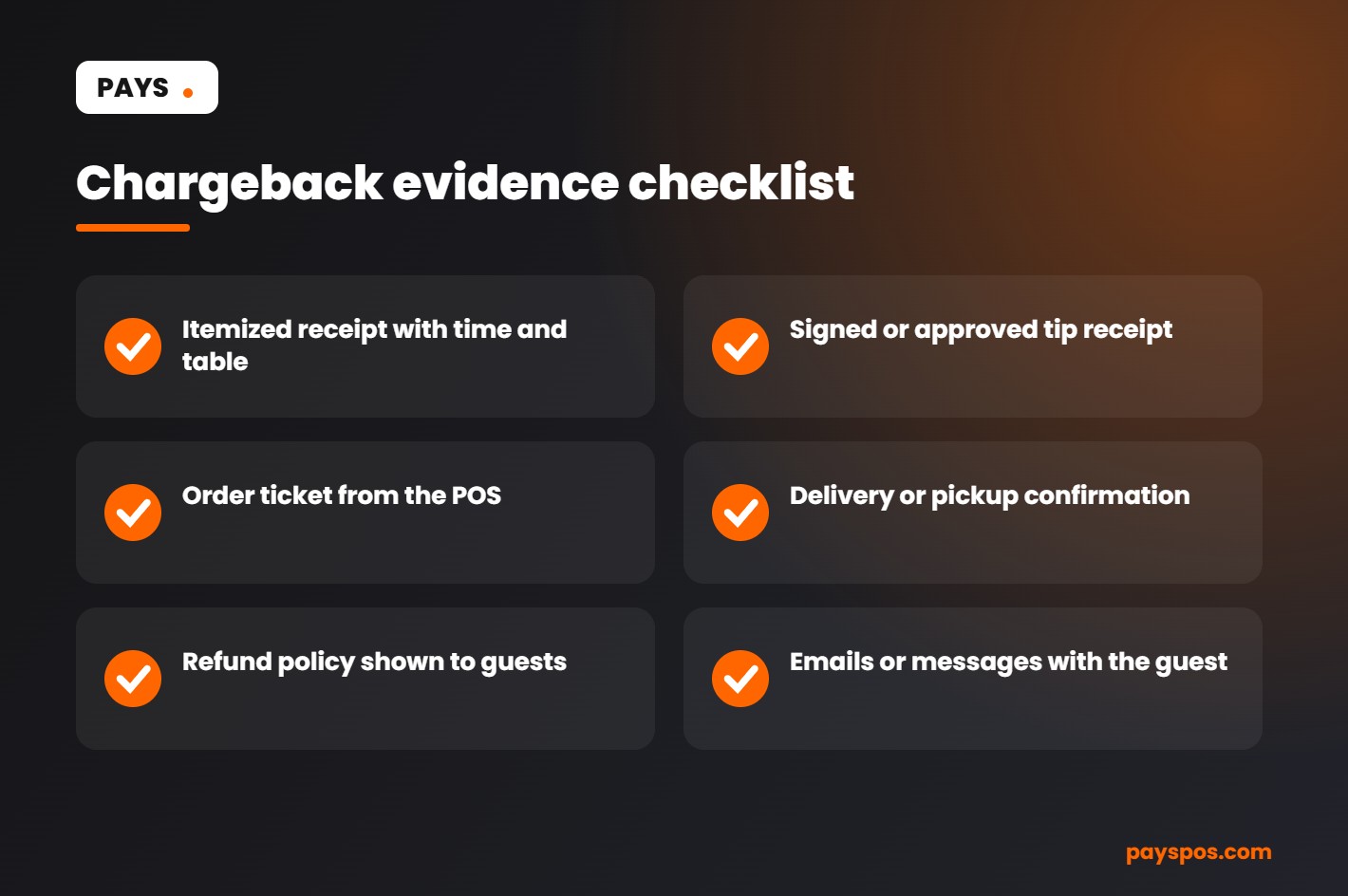
- Gather evidence. Itemized receipts, tip receipts, order tickets, delivery confirmation and communication with the guest.
- Write a short, factual response. Explain what happened in plain language and match each point to the evidence.
- Submit before the deadline. Late responses usually lose by default.
- Track the outcome. Learn from every case to prevent the next one.
What Good Evidence Looks Like
Strong evidence for restaurant chargebacks is clear, specific and tied to the transaction. Useful items include an itemized receipt showing the date, time, table or order number and items; the tip receipt or approved final amount; proof the card was dipped or tapped; delivery or pickup confirmation; and any messages with the guest.
Keep your response focused. Issuers review many cases, so a short explanation with well-labeled attachments works better than pages of text.
How to Prevent Restaurant Chargebacks
- Show a clear, recognizable business name on card statements.
- Use EMV chip and tap-to-pay terminals for every in-person sale.
- Take payment at the table with handhelds so cards never leave the guest’s sight.
- Train staff to enter tips carefully and avoid re-running cards.
- Print itemized receipts and keep digital copies in your POS.
- Post your refund and complaint policy and handle issues quickly.
- Keep delivery and pickup records for online orders.
- Review your chargeback reports every month.
Friendly Fraud in Restaurants
Friendly fraud happens when a cardholder disputes a charge they actually made. Sometimes it’s an honest mistake, such as forgetting a dinner or not recognizing the business name. Sometimes a family member made the purchase. Occasionally it’s a guest trying to get a free meal.
You can reduce friendly fraud with a recognizable statement name, clear receipts and quick responses to complaints. When it does happen, detailed records give you the best chance of winning.
Chargebacks and Your Payment Setup
Your POS and payment setup play a big role in preventing restaurant chargebacks. Modern terminals reduce fraud liability, handhelds keep cards in sight and good reporting makes evidence easy to find. If you use dual pricing, make sure prices are clearly shown on menus, screens and receipts so guests understand exactly what they’re paying.
The Pays POS works with Dejavoo, PAX and Valor hardware, supports handhelds for tableside payment and keeps detailed transaction records. It’s processor-agnostic, so you can bring your own processor, and there’s no long-term contract.
Common Restaurant Chargeback Scenarios
The forgotten dinner
A guest pays for a birthday dinner, then forgets about it by the time the statement arrives. The amount looks large, the name looks unfamiliar and they call their bank. Many restaurant chargebacks like this disappear when the statement name is clear and the receipt shows the date, time, items and table.
The disputed tip
A guest writes a $15 tip, but a server enters $50 by mistake. The guest sees a higher total than expected and disputes the whole bill. Careful tip entry, end-of-shift tip reviews and stored tip receipts protect you from this kind of dispute and from losing the full amount over a typing error.
The missing delivery
An online order shows as delivered, but the guest says it never arrived. Without a delivery record, the restaurant has little to show. Keeping order timestamps, delivery confirmation and any driver or guest messages gives you a fair chance in these restaurant chargebacks.
The stolen card
A stolen card is used for a large takeout order picked up by someone who never shows ID. The real cardholder disputes it as fraud. For high-value pickup orders, especially ones paid online, some restaurants verify the name on the order and watch for unusual patterns.
Understanding Your Chargeback Ratio
Card networks and processors watch your chargeback ratio, which compares the number of disputes to the number of transactions over a period. Exact thresholds depend on the program, but a rising ratio can bring warnings, monitoring programs, extra fees or a reserve on your funds. In serious cases, a processor may close the merchant account.
Most restaurants with in-person card payments see relatively few disputes, but online ordering, delivery and large catering orders can push the number up. Review your chargeback reports every month, look for patterns by order type or shift and fix the root cause instead of fighting the same dispute again and again.
Training Your Team to Prevent Disputes
Many restaurant chargebacks start with small front-of-house habits. A short training session can prevent most of them:
- Dip or tap every card, and never key in a card number by hand unless absolutely necessary.
- Check the POS before re-running a card that seemed to fail.
- Read tips back carefully and double-check large amounts.
- Give guests an itemized receipt every time.
- Call a manager when a guest is unhappy, before they leave.
- Note anything unusual about large takeout or online orders.
Make chargebacks part of your regular staff meetings. When a dispute happens, share what caused it and how to avoid it next time, without blaming the team member involved.
Online Ordering and Card-Not-Present Risk
Online and phone orders are convenient, but the card isn’t physically present, which shifts more fraud risk to the merchant. Restaurant chargebacks from online orders often involve stolen card details or guests claiming an order never arrived.
To reduce risk, require the card security code and billing ZIP code, watch for large orders to unusual addresses, keep clear order and delivery records and use the fraud screening tools your processor provides. For pickup orders, ask for the name on the order and match it to the guest collecting the food.
Catering and Large Orders
Large catering and group orders carry more risk because a single dispute can cost hundreds or thousands of dollars. Restaurant chargebacks on catering often come down to disagreements over what was ordered, delivered or promised.
Protect yourself with a written order confirmation that lists items, quantities, date, time, delivery address, total price and your cancellation policy. Ask the client to approve it by email or signature. Keep delivery confirmation and photos of the setup. These simple records make a huge difference if a dispute ever arrives.
Refunds vs Chargebacks
When a guest has a genuine complaint, a quick refund is usually cheaper than a chargeback. A refund settles the issue on your terms, keeps the guest relationship intact and avoids chargeback fees and ratio damage. A chargeback costs you the sale, a fee and staff time, and it counts against your record.
Give managers clear guidelines on when they can offer a refund, a credit or a free item. Empowering the team to fix problems on the spot prevents many restaurant chargebacks from ever starting.
A Monthly Chargeback Review Routine
Set aside 30 minutes each month to review disputes:
- List every chargeback with its date, amount, reason code and outcome.
- Group them by order type: dine-in, takeout, online, delivery and catering.
- Look for patterns, such as one shift, one server or one type of order.
- Fix the root cause with training, a process change or a setting in your POS.
- Track your win rate and total cost month over month.
Over time, this routine turns restaurant chargebacks from a surprise expense into a manageable, shrinking line item.
Building a Dispute-Ready Record System
The restaurants that win the most disputes are the ones that can find evidence in minutes. Store itemized receipts, tip receipts and order tickets digitally in your POS, and keep them for at least as long as cardholders can dispute a charge. Name and file catering confirmations and delivery records by date and order number.
When a dispute arrives, a manager should be able to search by date, amount or card ending and pull everything needed for a response the same day. That speed matters, because response windows are short and a strong, on-time reply is your best chance of recovering the money.
Frequently Asked Questions
How long does a guest have to file a chargeback?
Many cardholders have up to 120 days or more, depending on the card network and the type of dispute. Rules vary, so check with your processor.
Do restaurants pay a fee for chargebacks?
Most processors charge a fee for each chargeback, often whether you win or lose. Check your merchant agreement for the exact amount.
Can restaurants win chargebacks?
Yes. Restaurants with clear receipts, tip records and proof of a chip or tap payment often have a good chance, especially when they respond quickly.
What is the best way to prevent restaurant chargebacks?
Use modern chip and tap terminals, a recognizable statement name, tableside payment, careful tip entry, clear receipts and fast complaint handling.
Start with one change this week, such as fixing your statement name or switching every in-person payment to chip and tap. Small steps add up, and fewer restaurant chargebacks mean more of every sale stays with you.
Keep the Money You Earned
Restaurant chargebacks are a cost you can shrink. Know the rules, fix the common mistakes, keep strong records and respond quickly when a dispute arrives.
See how the Pays POS helps protect every payment or talk to our team. We’ll set you up in under a week, with no long-term contract.