It’s 12:10 on a Tuesday. The line is out the door, half the people are checking their watches, and a few are quietly walking to the place next door. Your food is great. The problem is that lunch only lasts so long.
That’s the reality of running a fast casual restaurant. Guests want food that feels a step above fast food, made fresh with better ingredients, but they want it almost as fast. Get the speed right and the model is one of the strongest in the industry. Get it wrong and even the best menu struggles.
This guide covers what makes a fast casual restaurant work, how to design your menu, line and kitchen for speed, how self-order kiosks and online ordering fit in, and the numbers to watch so busy days turn into profitable ones.
What Is a Fast Casual Restaurant?
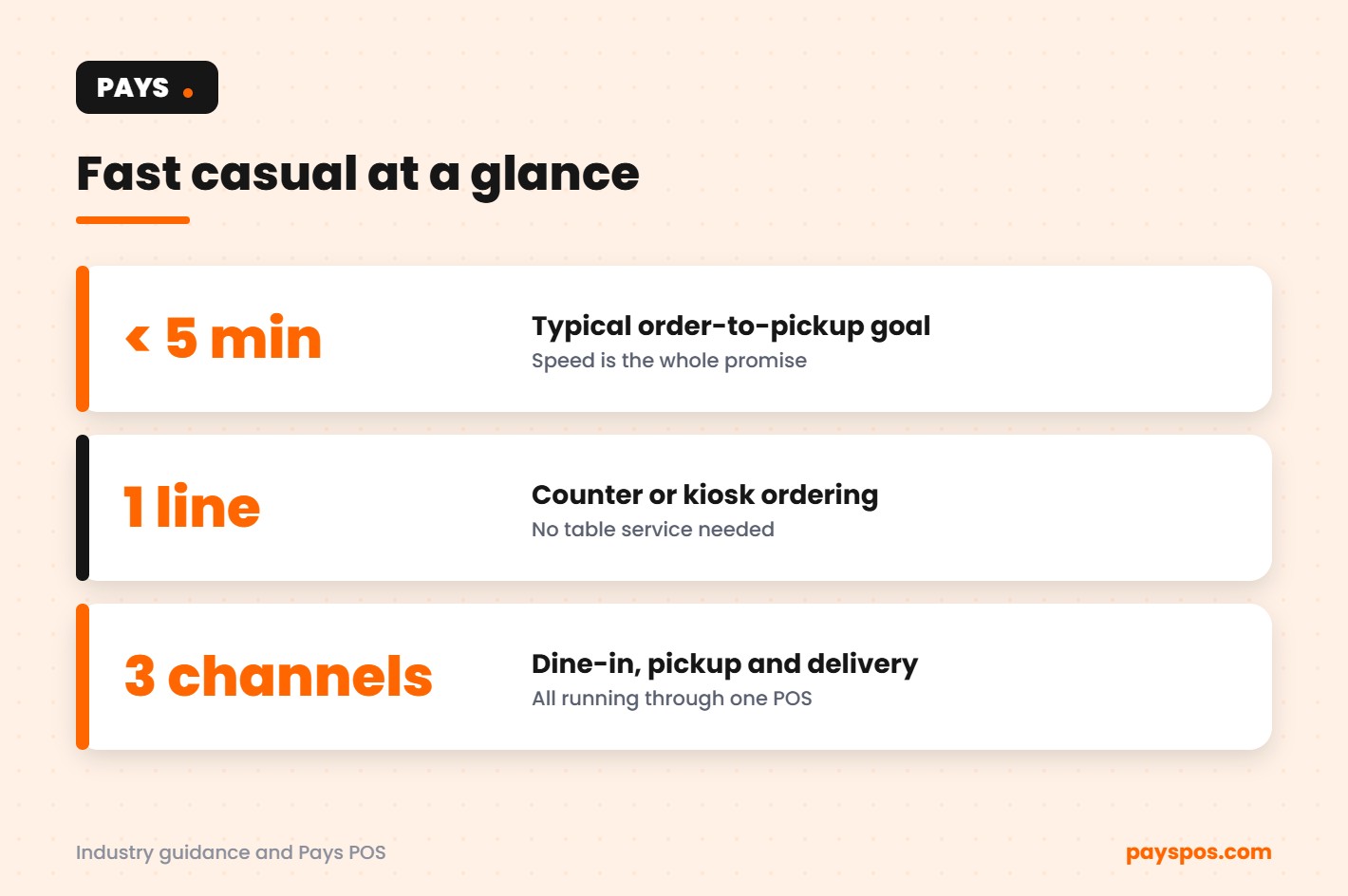
A fast casual restaurant sits between quick service and casual dining. Guests usually order at a counter or kiosk, pay up front and either take their food to go or sit down without full table service.
What separates fast casual from fast food is the experience: fresher ingredients, more customization, a nicer space and food that feels made for you. Think build-your-own bowls, burritos, salads, burgers, poke, pizza and sandwiches.
What separates it from casual dining is speed and simplicity. There’s no server taking orders at the table, no long wait for the check, and the whole visit can take 20 minutes.
Why the Fast Casual Restaurant Model Works
- Lower labor per guest. Counter ordering and kiosks reduce the need for a full front-of-house team.
- Higher volume. A well-run line can serve hundreds of guests during a single lunch rush.
- Strong takeout and delivery. Fast casual food travels well, so pickup and delivery add sales without adding seats.
- Customization sells. Add-ons like extra protein, premium toppings and sides raise the average ticket.
The catch is that every advantage depends on speed. A slow fast casual restaurant loses the very thing guests came for.
1. Build a Menu That Moves
Your menu is the single biggest factor in how fast your line moves. Most successful fast casual concepts keep a focused core menu of roughly 8 to 12 items, built from a shared set of ingredients.
Ask three questions about every item:
- Can it be assembled in under a minute once the order hits the line?
- Does it use ingredients already on the line for other items?
- Does it hold up for takeout and delivery?
If the answer to any of these is no, the item probably belongs on a limited-time menu rather than the core lineup.
Customization is great, but structure it. A clear build path, like base, protein, toppings, sauce, keeps guests moving and makes orders easier to read in the kitchen.
2. Map Your Line Station by Station
Walk through an order from the moment a guest steps in to the moment they leave with food. Every step, every handoff and every reach adds seconds.
- Where does the guest order and pay?
- How does the ticket reach the kitchen?
- Which station starts the order, and which finishes it?
- Where do pickup and delivery orders wait?
- Where do guests grab drinks, napkins and utensils?
A fast casual restaurant should flow in one direction. Guests and food should never cross paths or double back. Even moving the drink station a few feet can noticeably shorten the line.
3. Use Self-Order Kiosks to Split the Line
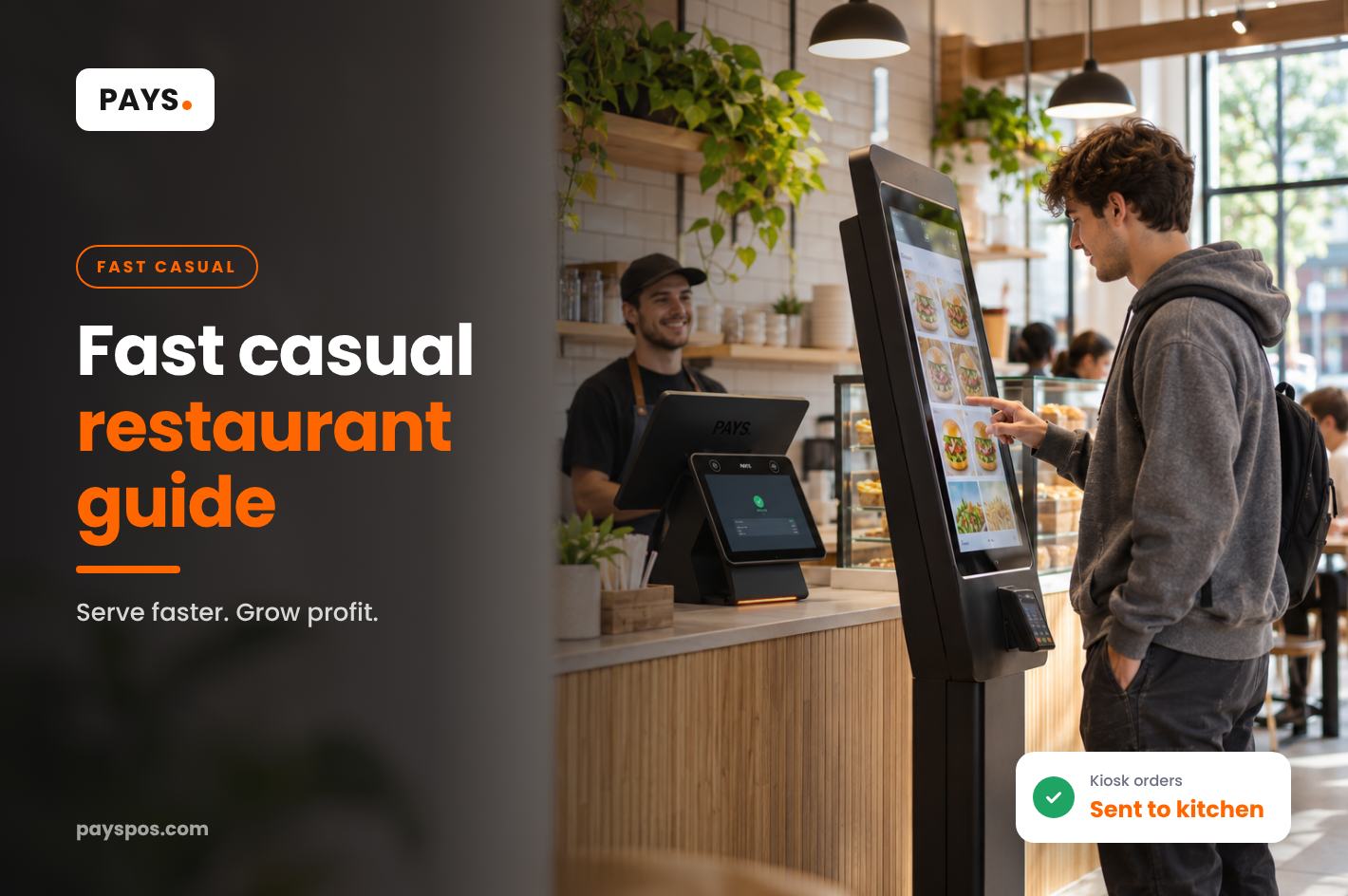
Self-order kiosks have become a standard tool in fast casual. Guests who know what they want can order and pay on their own, while others still use the counter.
The benefits go beyond speed:
- Shorter perceived wait. Several guests can order at once instead of waiting single file.
- More accurate orders. Guests enter their own modifiers, so there’s less miscommunication.
- Built-in upsells. Kiosks can suggest sides, drinks and extras every single time.
- Staff freed up. Team members can focus on making food and helping guests instead of taking every order.
Pays offers self-order kiosks that connect directly to the POS and kitchen. You can read more in our guide to self-order kiosks for restaurants.
4. Put a Kitchen Display on Every Station
Paper tickets fall off rails, get smudged and arrive out of order, especially when counter, kiosk, online and delivery orders all land at once.
A kitchen display system shows every ticket in sequence with modifiers clearly listed. Timers show which orders are running late, and stations can bump tickets as they finish. For a fast casual restaurant handling several order channels, it’s one of the easiest ways to keep the line calm and accurate.
5. Make Online Ordering a Second Front Door
Many guests would rather skip the line entirely. Online ordering for pickup lets them order ahead, pay in advance and grab their food from a dedicated shelf.
To make it work:
- Set up a clear pickup area separate from the main line.
- Give accurate ready times, and pace orders so the kitchen doesn’t get buried.
- Label every bag with the guest’s name and order number.
- Make sure online orders reach the kitchen the same way as counter orders.
Direct online orders also avoid marketplace commissions, which makes them some of the most profitable orders a fast casual restaurant can take.
6. Bring Delivery Apps Into One System
Delivery apps can add real volume, but juggling a separate tablet for each one causes missed orders and retyping errors. With delivery app integrations, Uber Eats, DoorDash and Grubhub orders flow straight into your POS and kitchen display.
Price your delivery menu with commissions in mind. Many restaurants set app prices slightly higher than in-store prices to protect margin.
7. Price for Margin, Not Just Volume
Fast casual restaurants can be very busy and still struggle with profit. Watch your food cost carefully. Many operators aim for food cost somewhere around 28% to 35% of the menu price, depending on the concept.
A few pricing habits help:
- Price premium add-ons like extra protein and guacamole to earn real margin.
- Build combos that include a high-margin drink or side.
- Review prices every quarter as ingredient costs change.
- Consider a dual pricing program to offset card processing fees on every order.
8. Staff and Train for the Rush
A fast casual restaurant lives and dies by its peak hours. Use your sales data to schedule more people during lunch and dinner rushes and fewer during slow afternoons.
Cross-train your team so people can move between stations when one gets slammed. A clear training plan, with a station checklist and target times, helps new hires get up to speed quickly.
9. Watch the Right Numbers
Every fast casual restaurant should track a handful of numbers weekly:
- Speed of service: Average time from order to pickup.
- Throughput: Orders per 15 minutes during peak hours.
- Average ticket: Are add-ons and combos working?
- Sales by channel: Counter, kiosk, online and delivery.
- Food and labor cost: As a percentage of sales.
With real-time reporting in your POS, all of these are available in seconds instead of hours.
10. Keep Guests Coming Back
Fast casual guests are often regulars who visit several times a week. Reward them. A simple loyalty program, easy reordering online and a friendly team turn a quick lunch into a habit.
Ask for reviews, respond to feedback and keep your core items consistent. Guests come back because they know exactly what they’ll get.
Fast Casual Restaurant Launch Checklist
If you’re opening a new fast casual restaurant or reworking an existing one, use this checklist:
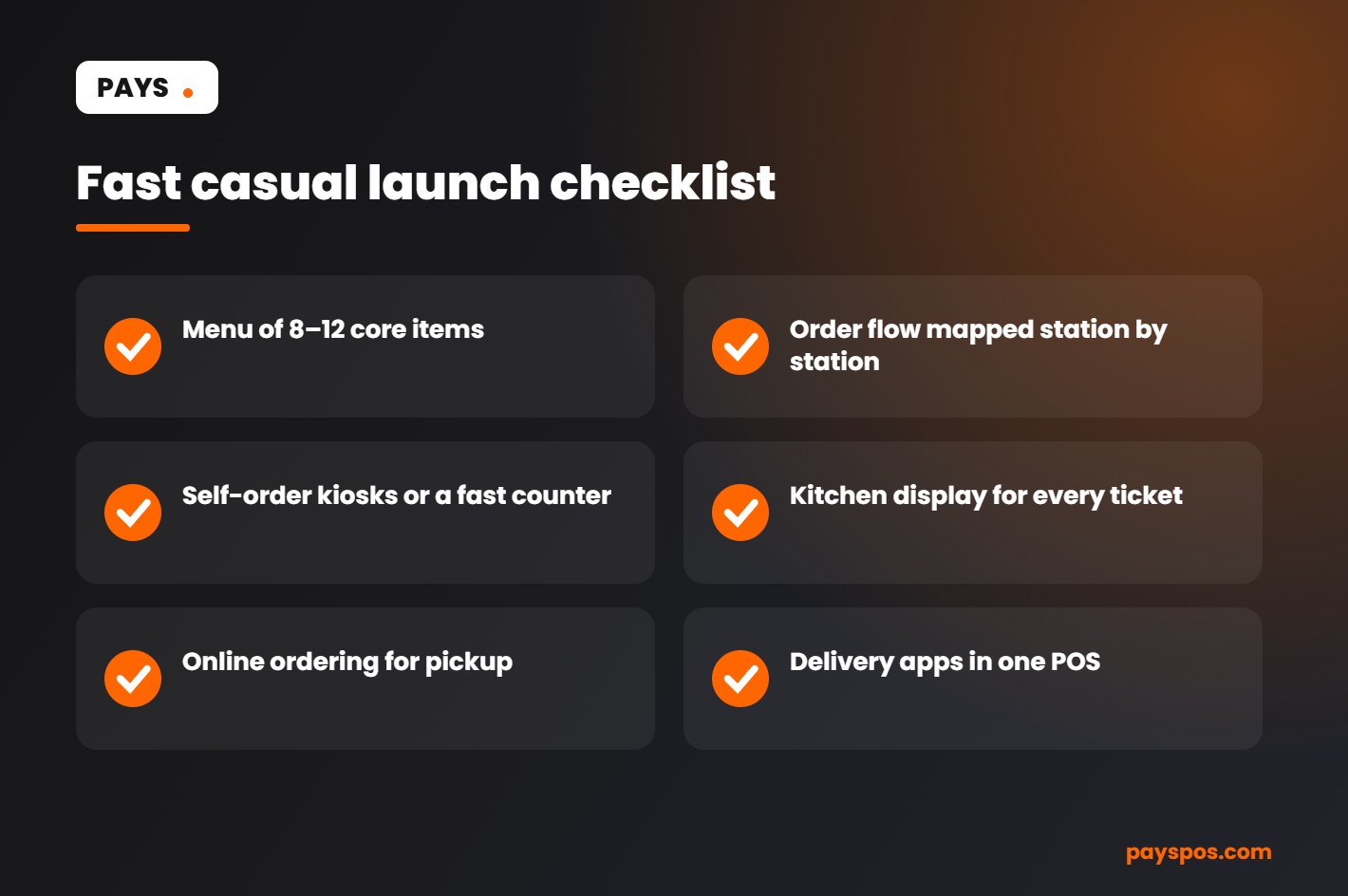
- A focused core menu built from shared ingredients
- A one-way line with clear stations and handoffs
- Self-order kiosks or a fast counter checkout
- A kitchen display at every station
- Online ordering with a dedicated pickup shelf
- Delivery apps integrated into one POS
- Weekly reports on speed, ticket and food cost
Opening a Fast Casual Restaurant: The Planning Basics
If you’re starting from scratch, a few early decisions shape everything else.
Location. Fast casual thrives near offices, campuses, shopping centers and busy residential streets. Lunch traffic matters most for many concepts, so look at where people work as well as where they live. Parking or easy walk-up access is important for pickup orders.
Size. Many fast casual spaces are smaller than full-service restaurants because seating needs are lower. A compact space with a well-designed line can outperform a larger one with a messy layout.
Business plan. The SBA’s business plan guide is a helpful starting point. Your plan should include a realistic sales forecast based on guests per hour during peak times, not just a monthly total.
Technology. Choose your POS, kiosks, kitchen display and online ordering together, so everything talks to everything else from day one. Pays builds your menu for you, trains your staff and gets most restaurants live in under a week, with no long-term contract.
A Lunch Rush That Actually Works
Picture a well-run Thursday. By 10:45 the line is stocked, sauces are labeled and the kitchen display is clear. Online pickup orders for 11:30 have already started arriving, paced so the kitchen can handle them alongside walk-ins.
At 11:55 the first big wave hits. Two kiosks take orders from regulars who know exactly what they want, while one team member at the counter helps first-time guests with questions. Every ticket lands on the kitchen screen in order, with modifiers in bold.
The protein station sees what’s coming and starts the next batch before it runs out. Delivery drivers walk straight to a labeled shelf instead of crowding the counter. By 1:30, the team has served more guests than last week, and nobody had to shout an order across the kitchen.
None of this happens by accident. It’s the result of a tight menu, a smart layout, connected technology and a team that knows exactly where to stand.
Menu Engineering in a Few Simple Steps
Menu engineering sounds complicated, but the basics are straightforward. Look at two numbers for every item: how many you sell and how much profit each one makes.
- Popular and profitable: Keep these front and center. Feature them on kiosks and menu boards.
- Popular but low margin: Adjust the recipe, portion or price slightly, or pair them with a high-margin side.
- Profitable but slow: Promote them with better photos, placement or a limited-time push.
- Neither popular nor profitable: These are candidates to remove.
Your POS sales reports give you the first number. Your recipe costing gives you the second. Review both every quarter and your menu stays lean and profitable.
Packaging for Pickup and Delivery
A growing share of orders leave the building, so packaging is part of the guest experience. Soggy fries or a spilled sauce can undo a great meal.
- Use vented containers for anything crispy.
- Pack sauces and dressings on the side.
- Seal bags with a sticker that shows the order number and guest name.
- Include utensils and napkins only when guests ask for them, to cut waste and cost.
Test every item the way guests receive it: after a 20-minute drive. If it doesn’t hold up, adjust the recipe or the packaging.
Hiring People Who Fit the Pace
Speed is a team sport. When hiring, look for people who stay calm under pressure, communicate clearly and enjoy a busy environment. Experience helps, but attitude and reliability often matter more.
Give every new hire a clear first week: one station at a time, with a checklist and a buddy. Use your POS to set up individual logins and simple roles, so each person sees only what they need. A well-trained team is the fastest upgrade you can make.
Common Fast Casual Restaurant Mistakes
- Too many menu items. Complexity slows the line and increases waste.
- A line that doubles back. Guests and food crossing paths causes confusion and delays.
- No plan for online orders. Pickup orders piling up on the counter frustrate everyone.
- Separate tablets for every app. Missed and retyped orders cost money and reviews.
- Ignoring card fees. On high-volume, lower-ticket orders, fees add up fast.
- Chasing volume over profit. Busy doesn’t always mean profitable.
How Technology Ties It All Together
The best fast casual restaurant operations feel effortless to guests because the systems behind them are connected. A guest orders on a kiosk, the ticket appears instantly on the kitchen display, the food is ready in minutes and the sale shows up in real-time reports.
With Pays POS, a fast casual restaurant gets:
- Counter, kiosk, handheld and online ordering in one system
- Uber Eats, DoorDash and Grubhub orders on the same screen
- Kitchen display system for every station
- Dual pricing to offset card processing fees
- Real-time reporting by channel, item and hour
- Hardware from Dejavoo, PAX and Valor, and the freedom to bring your own processor
Learn more about our POS for fast casual restaurants.
Growing From One Location to Several
Many successful concepts start with one store and grow from there. Before opening a second location, make sure the first one runs smoothly without the owner on the line every day.
- Document everything. Recipes, station setups, opening and closing checklists and training steps.
- Standardize the menu. Guests expect the same bowl at every location.
- Centralize reporting. Compare sales, speed and food cost across stores from one dashboard.
- Keep technology consistent. The same POS, kiosks and kitchen screens at every location make training and support simpler.
Growth works best when the systems are ready before the second set of doors opens. Strong numbers at the first store also make conversations with landlords, lenders and partners much easier.
Frequently Asked Questions
What is the difference between fast food and a fast casual restaurant?
Both are quick, but a fast casual restaurant typically offers fresher ingredients, more customization and a nicer dining space, usually at a somewhat higher price.
How fast should service be in a fast casual restaurant?
Many operators aim for just a few minutes from order to pickup. Track your own average and work to improve it during peak hours.
Do fast casual restaurants need self-order kiosks?
Not always, but kiosks help split the line, improve order accuracy and add upsells, especially for busy locations.
What food cost should a fast casual restaurant target?
Many concepts aim for food cost around 28% to 35% of menu price, but the right number depends on your menu and pricing.
What POS is best for a fast casual restaurant?
Look for kiosk and online ordering support, delivery integrations, a kitchen display and real-time reports. Pays POS includes all of these.
Can a small team run a fast casual restaurant?
Yes. With a focused menu, kiosks or online ordering and a kitchen display, a small trained team can handle a busy lunch. Scheduling to your sales data keeps labor in line on slower days.
Speed Is the Strategy
Every decision in a fast casual restaurant, from the menu to the layout to the technology, should make the guest’s visit faster and easier. When it does, volume and loyalty follow.
See how Pays POS for fast casual restaurants keeps the line moving, or talk to our team about getting set up in under a week.