
Every food truck owner remembers the first time a line formed. Twenty people deep, the generator humming, tickets stacking up, and one thought running through your head: please don’t let the card reader die right now.
A food truck business looks simple from the sidewalk. A window, a menu board, a great smell. Behind that window is a small, mobile restaurant with all the same problems as a brick-and-mortar place, squeezed into about 150 square feet and moving to a new address every few days.
This guide walks through how to start a food truck business the way experienced operators actually do it: with honest numbers, the permits nobody warns you about, menus built for speed, and the technology that keeps a busy window running. Whether you’re still sketching ideas or already own a truck, you’ll find something here to use this week.
Is a Food Truck Business Still Worth It in 2026?
Short answer: yes, if you go in with clear eyes.
The appeal hasn’t changed. Compared with a full restaurant, a truck needs far less capital, has no long lease, and lets you go where the customers are. Lunch in the business district, a brewery in the evening, a festival on Saturday. If one spot dies, you move.
What has changed is the competition and the cost base. Food, fuel, insurance and labor all cost more than they did a few years ago. Customers also expect the same things they get from restaurants: card and tap payments, online ordering, quick service and accurate orders.
The trucks that win treat the operation like a real business from day one. The ones that struggle treat it like a hobby with a kitchen attached.
Step 1: Get Honest About Food Truck Business Startup Costs
Most new owners underestimate this part, so let’s start here.
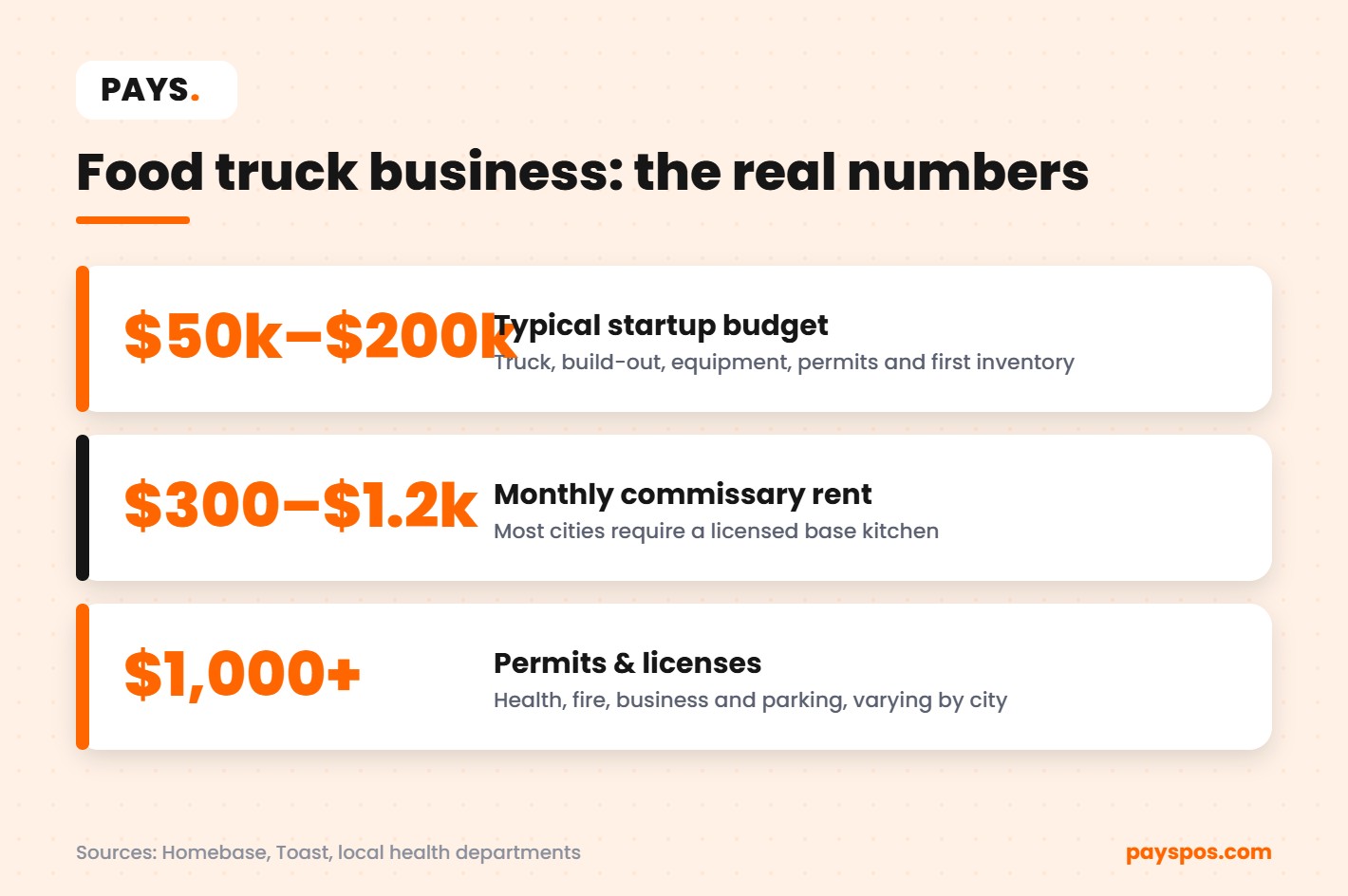
Industry guides from scheduling platform Homebase put typical startup budgets somewhere between $50,000 and $200,000. That’s a wide range because the biggest line item, the truck itself, swings so much.
- The truck: A used truck often lands in the $30,000 to $70,000 range. A brand-new custom build can cost well over $100,000.
- Kitchen equipment: Fryers, flat tops, refrigeration, a hood system and fire suppression. Often included in a used truck, but check age and condition.
- Wrap and branding: Your truck is your billboard. A good wrap is a marketing expense, not decoration.
- Permits and licenses: Often over $1,000 in total, and this varies a lot city by city.
- Commissary kitchen: Commonly $300 to $1,200 per month.
- POS and payment hardware: A reliable terminal and ideally a handheld for line-busting.
- Opening inventory, insurance and a cash cushion: Plan for at least three months of operating costs.
That last point, the cushion, is the one people skip. Weather, a slow festival season or a breakdown can wipe out a month of revenue. Having reserves is what lets a food truck business survive its first bad stretch.
Step 2: Pick a Concept You Can Serve in Under Three Minutes
A food truck is a speed business. Every food truck business concept has to work through a single window, with two or three people inside, during a 90-minute lunch rush.
Ask yourself three questions about every concept you’re considering:
- Can most items be finished in three minutes or less? Long cook times kill your line.
- Do the ingredients overlap? Five dishes built from the same eight ingredients means less waste and less storage.
- Can people eat it standing up? Tacos, bowls, sandwiches and handhelds win. Anything that needs a knife and fork is harder.
The most successful trucks usually do one thing very well. A tight menu of five to eight items is easier to prep, faster to serve and simpler to price. It also makes your brand easier to remember.
Step 3: Write a Food Truck Business Plan (Even a Short One)
You don’t need a 40-page document. You do need a plan that answers the hard questions before you spend money.
The U.S. Small Business Administration has free templates that work well for a food truck business. At a minimum, your plan should cover:
- Your concept and who you’re serving
- Where you’ll park and how often
- Startup costs and how you’ll fund them
- Your menu and the food cost of each item
- A realistic sales forecast: tickets per hour, average check, days per week
- Your break-even point
The sales forecast is where the plan earns its keep. If you need 120 tickets a day at $14 each to break even, and your best spot only does 60, you know before signing anything that something has to change.
Step 4: Handle Licenses, Permits and Health Rules
This is the least fun step, and the one most likely to delay your launch.
Requirements vary by city and county, but most food truck operators need some combination of:
- A business license and an EIN
- A mobile food vendor permit
- A health department permit, usually with an inspection of the truck
- Food handler certifications for staff
- A fire department inspection, especially if you use propane
- Seller’s permit for sales tax
- Parking or zoning permits for specific locations
Call your local health department early. Ask what they need, what inspections are required and how long approval takes. Some cities have waiting lists or caps on mobile vendor permits, so it pays to know that before you buy a truck.
Also check whether your city requires you to operate from a licensed commissary. Most do.
Step 5: Line Up a Commissary Kitchen
A commissary is a licensed commercial kitchen where you prep food, store supplies, fill fresh water, dump grey water and often park overnight.
Many health departments require one for any food truck business, and even where it isn’t required, it makes life easier. Prepping in a full kitchen is faster than prepping in the truck, and it means the truck can arrive at a service ready to sell.
When comparing commissaries, look beyond the monthly price. Check:
- Hours of access (can you get in at 5 a.m.?)
- Cold and dry storage space
- Overnight parking and power hookups
- Distance from your best selling locations
Step 6: Choose the Right Truck
New or used is the big decision. A used truck saves money upfront but can bring repair bills. A new build costs more but is designed around your menu.
If you go used, have a mechanic inspect the engine and a kitchen equipment tech check the appliances, gas lines and fire suppression system. Ask for maintenance records. A truck that can’t drive is a food truck business that can’t earn.
Think about layout too. Where does the order window sit relative to the pass? How many people can work inside without colliding? Where does the POS go so the cashier can see the customer and the kitchen at the same time?
Step 7: Price Your Menu for Real Profit
Pricing is where many a food truck business quietly loses money.
Start with food cost per item. Most operators aim for food cost around 28% to 35% of the menu price. Then layer in packaging, which is a bigger expense for trucks than for sit-down restaurants, and card processing fees.
Card fees deserve special attention. Most food truck customers pay by card or phone. At 3% on every sale, that’s a meaningful bite out of a thin margin. One option many operators use is a dual pricing program, which shows a cash price and a card price so the business isn’t absorbing the full fee on every transaction.
Review your prices every quarter. Ingredient costs move, and a price that worked in spring may lose money by fall.
Step 8: Set Up a POS Built for a Moving Kitchen
Your point of sale system is the heartbeat of a food truck business. It takes orders, takes payments, sends tickets to the cooks and tells you what’s selling.
For a truck, a few features matter more than usual:
- Fast checkout: Tap, chip and swipe, with tips handled in seconds.
- Handheld ordering: A handheld POS lets someone walk the line and take orders before people reach the window.
- Kitchen tickets that don’t get lost: A kitchen display system keeps orders in sequence even when the wind is blowing paper tickets everywhere.
- Online ordering: Let regulars order ahead so their food is ready when they walk up.
- Real-time reporting: Know which location, day and menu item actually makes money.
Pays POS offers a food truck POS system built around exactly this. The menu is built for you, staff are trained, and most businesses are live in under a week with no long-term contract.
Step 9: Find Locations That Actually Sell
A great menu in the wrong spot will still struggle. For any food truck business, location is the single biggest lever on daily sales.
Good locations for a food truck business usually share a few traits: lots of foot traffic, few nearby food options and a crowd with a specific window of time to eat. Think office parks at lunch, breweries without kitchens, construction sites, college campuses and late-night bar districts.
Track every stop. Record tickets, sales and average check by location and day of the week. After a month, the pattern is usually obvious. Some spots deserve a weekly slot. Others aren’t worth the fuel.
Private events are another strong channel. Weddings, corporate lunches and parties often pay a guaranteed minimum, which smooths out the uncertain days.
Step 10: Market Your Truck Like a Local Brand
Marketing a food truck business is different. Customers can’t find you by walking past the same building every day, so they need to know where you’ll be.
- Post your weekly schedule on Instagram, Facebook and Google Business Profile every Monday.
- Use daily stories to show the line, the food and today’s special.
- Build a regulars list through a simple loyalty program or text club.
- Partner with breweries and venues that bring their own crowd.
- Ask for reviews with a QR code on the window or the receipt.
Consistency beats flashiness. A truck that shows up at the same brewery every Thursday becomes part of people’s routine.
Step 11: Keep the Food Truck Business Profitable After Launch
Opening is the start, not the finish line. The trucks still running five years later tend to share a few habits.
They watch numbers weekly. Sales by location, food cost, labor and best sellers. Real-time reports make this a five-minute task instead of a Sunday-night spreadsheet.
They maintain the truck. Scheduled maintenance on the engine, generator and equipment prevents the breakdown that wipes out a festival weekend.
They trim the menu. If an item sells poorly or slows the line, it goes.
They add revenue channels. Catering, private events and online pre-orders all help even out slow weeks.
They protect margin on every sale. Card fees, waste and comped items add up. Small leaks become big ones over a year.
Common Mistakes That Sink a New Food Truck Business
Most failures come from a handful of avoidable mistakes:
- Too big a menu. More items means slower service and more waste.
- No cash cushion. One repair or a rainy month shouldn’t end the business.
- Ignoring permit timelines. A truck sitting in the driveway waiting for approval still costs money.
- Unreliable payments. If cards decline or the system freezes during a rush, people leave the line.
- Not tracking location data. Without numbers, you’re guessing where to park.
- Underpricing. Many new owners price to match competitors instead of pricing to cover their own costs.
What a Good Day Looks Like
Picture a Thursday that’s working. You prep at the commissary by 9. You’re parked at the office park by 11 with your location posted online. Pre-orders are already coming in.
When the rush hits, one person takes orders on a handheld down the line, the kitchen display keeps tickets in order, and payments clear in seconds. By 2 p.m. you’ve done 140 tickets, and you can see on your phone that the new chicken bowl outsold the old favorite.
That evening you’re at a brewery. The next morning you check yesterday’s numbers in two minutes and order exactly what you need.
That’s what a well-run food truck business feels like. It’s still hard work, but you’re steering instead of reacting.
Your Food Truck Business Launch Checklist
Before your first service, run through this list. If any line is still open, it’s usually cheaper to delay opening by a week than to fix it in the middle of a rush.
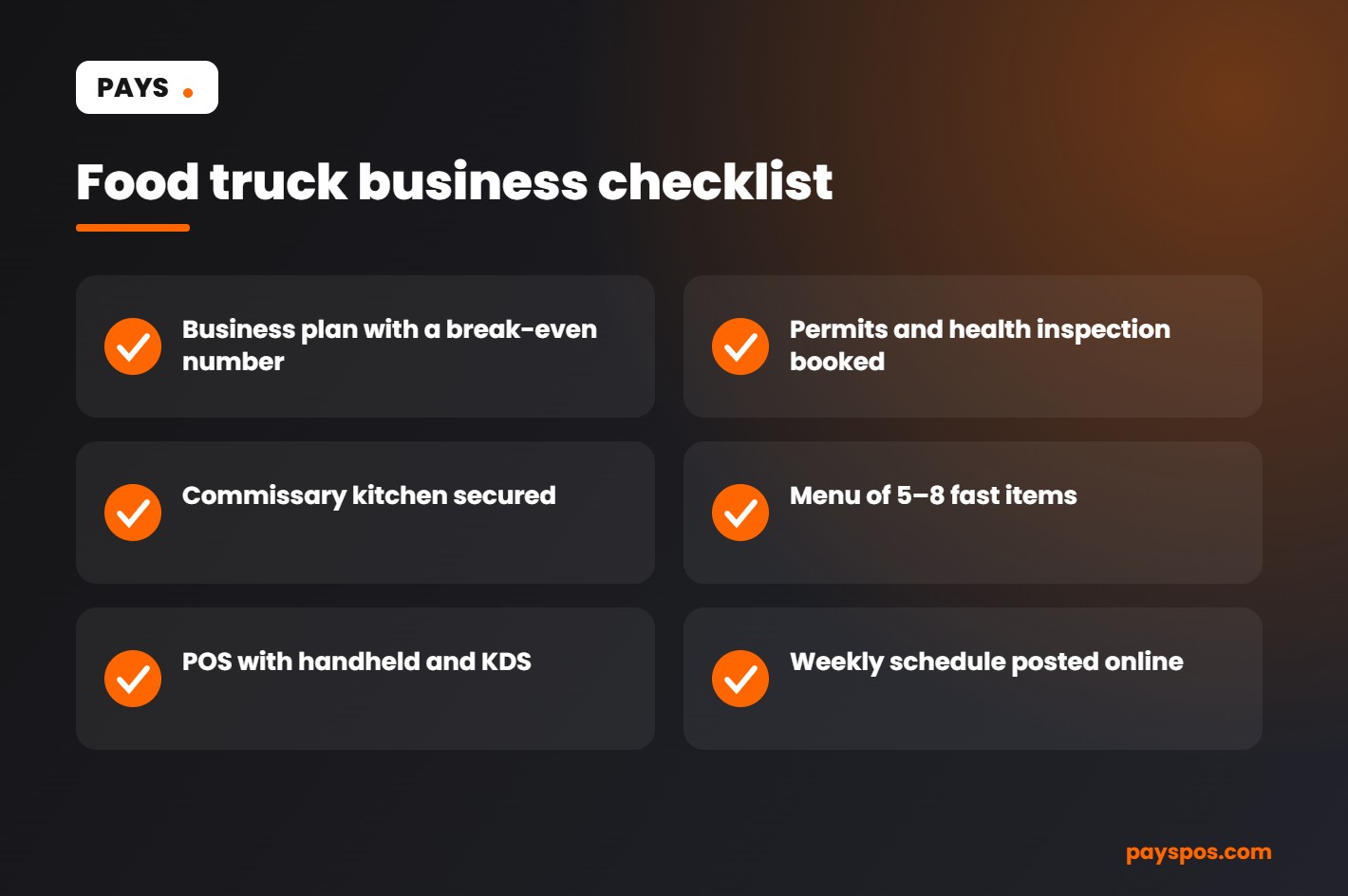
- A written plan with a break-even number. You should know exactly how many tickets a day keep your food truck business above water.
- All permits approved and posted. Keep copies in the truck. Inspectors and event organizers will ask.
- Commissary agreement signed. Confirm access hours, storage space and parking.
- A tight menu tested at full speed. Run a mock rush with friends and time every ticket.
- POS, handheld and kitchen display set up. Test tap, chip, tips and refunds before you open the window.
- Your first month of locations booked. Mix reliable lunch spots with evening venues and one or two events.
- Social profiles live with a schedule posted. Your food truck business needs followers before it needs a crowd.
Soft Launch Before the Big Launch
Many experienced owners run a soft launch: two or three low-pressure services at a friendly venue, often a brewery or an office that already knows them. The goal isn’t sales. It’s finding the problems.
Maybe the fryer can’t keep up. Maybe the order window is too high for shorter customers to tap a card. Maybe one menu item takes six minutes instead of three. Every one of these is easy to fix on a quiet Tuesday and painful to fix at a sold-out festival.
Use the soft launch to check your POS data too. Are items named clearly on the kitchen display? Do modifiers like “no onions” show up where the cook can see them? Are tips recorded correctly? A food truck business lives and dies by small details like these.
Plan for the Seasons
Weather shapes the calendar for almost every food truck business. Summer brings festivals and long evenings. Winter, in many parts of the country, brings slow days and cancelled events.
Plan your year in advance. Build catering and private event bookings into the slow months, adjust your menu for the season and use your sales history to staff and order correctly. The owners who survive their first winter usually planned for it in June.
Frequently Asked Questions
How much does it cost to start a food truck business?
Most startup budgets land between $50,000 and $200,000, depending mainly on whether you buy a used or new truck. Add permits, commissary rent, equipment, insurance and a cash reserve of at least three months.
Do I need a commissary kitchen for a food truck?
In many cities, yes. Health departments often require a licensed base kitchen for prep, storage, water and waste. Check with your local health department before you buy anything.
How long does it take to open a food truck business?
Many owners take three to six months from planning to first service. Permits and truck buildout are usually the longest steps.
What is the best POS for a food truck?
Look for fast payments, handheld ordering, a kitchen display, online ordering and real-time reports. Pays POS covers all of these, builds your menu for you and gets most businesses live in under a week.
Is a food truck business profitable?
It can be. Profit depends on location, menu pricing, food cost and how well you control expenses like waste and card fees. Tracking sales by location is the fastest way to improve profitability.
Ready to Roll?
A food truck business rewards owners who plan carefully and move fast. Get the numbers right, build a menu for speed, and set up technology that keeps the line moving.
If you want a POS that’s ready for your window, see how the Pays food truck POS works or talk to our team. We’ll build your menu, train your staff and get you serving in under a week.